Breast tumour classification using ultrasound images
Objective
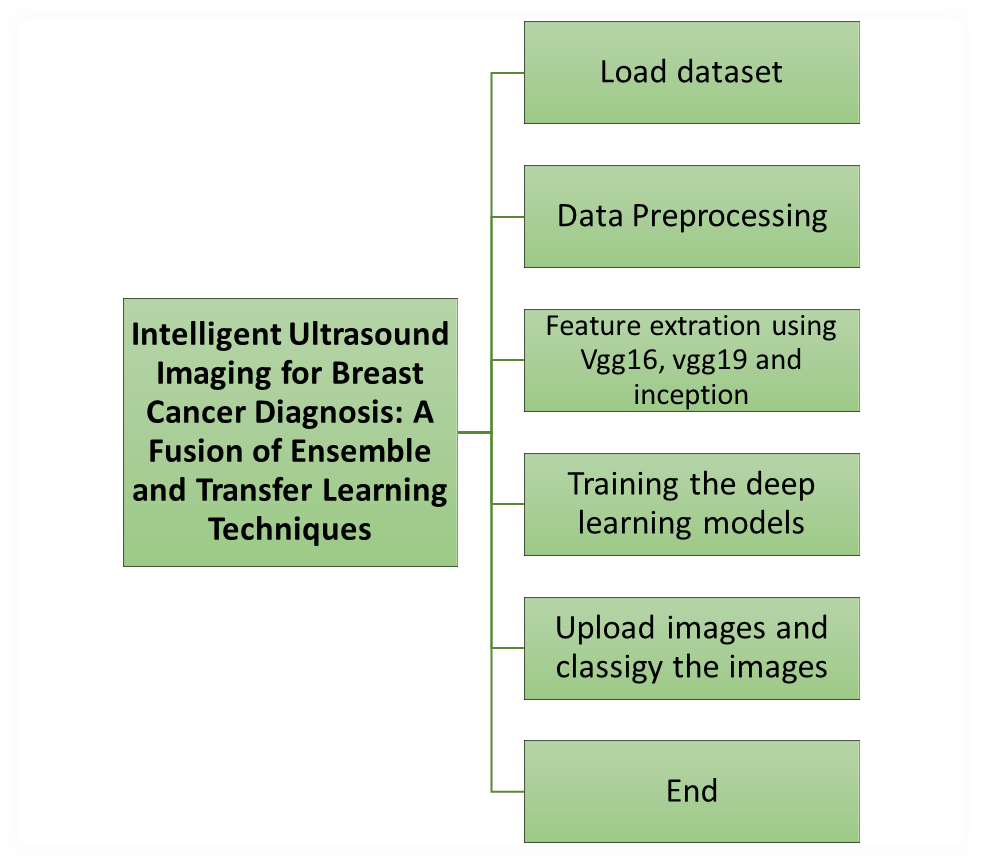
This project develops an intelligent system for breast cancer diagnosis using ultrasound images, leveraging deep learning techniques like transfer learning and ensemble methods. It combines feature extraction from pre-trained models (MobileNet, VGG19, InceptionV3) with classifiers such as SVM, Random Forest, and RNN, a hybrid model using soft voting for improved accuracy, this hybrid model is compared with one other model which involved feature extraction techniques with (VGG19, VGG16 and inception net) and final model trained is SVM.
Abstract
"Intelligent Ultrasound Imaging for Breast Cancer Diagnosis: A Fusion of Ensemble and Transfer Learning Techniques”
ABSTRACT
Breast cancer is one of the leading causes of death among women worldwide, and early detection plays a critical role in improving survival rates. Ultrasound imaging is a widely used, non-invasive diagnostic method, but it requires expert analysis, which can lead to delays or inaccuracies. This project presents an intelligent system for breast cancer diagnosis using ultrasound images by leveraging deep learning techniques, including transfer learning and ensemble methods. The proposed methodology combines feature extraction from pre-trained models (MobileNet, VGG19, InceptionV3) with machine learning classifiers, such as Support Vector Machine (SVM), Random Forest (RF), and Recurrent Neural Networks (RNN). The ensemble approach integrates predictions from all three classifiers using soft voting to improve the accuracy and reliability of the diagnosis. The system classifies breast lesions into three categories: Benign, Malignant, and Normal. The dataset consists of ultrasound images from multiple categories, and the model is trained and evaluated using cross-validation techniques. The results show a significant improvement in accuracy, with the ensemble model achieving a decent accuracy, surpassing the performance of traditional methods. This system aims to assist healthcare professionals by providing accurate, automated classification, ultimately contributing to faster and more reliable breast cancer detection.
Keywords: Ensemble Transfer Learning, Ultrasound Imaging, Breast Cancer Diagnosis, Machine Learning Models, Data Augmentation, Pre-processing Techniques, UBC Benchmark Dataset, Cross-validation, Feature Extraction, Classification Algorithms
NOTE: Without the concern of our team, please don't submit to the college. This Abstract varies based on student requirements.
Block Diagram
Specifications
SOFTWARE HARDWARE REQUIREMENTS
H/W CONFIGURATION:
Processor - I3/Intel Processor
Hard Disk - 160GB
Key Board - Standard Windows Keyboard
Mouse - Two or Three Button Mouse
Monitor - SVGA
RAM - 8GB
S/W CONFIGURATION:
• Operating System : Windows 7/8/10
• Server side Script : HTML, CSS, Bootstrap & JS
• Programming Language : Python
• Libraries : Flask, Pandas, MySQL. Connector, Tensor flow, Keras
• IDE/Workbench : VS Code
• Technology : Python 3.8+
• Server Deployment : Xampp Server


 Paper Publishing

Request Call Back
Would you like to receive a free callback now?
Choose the best time for callback:
Leave your message and we will contact you as soon as possible

6-2-85/B, Old Maternity Hospital Road, Thyagaraja Nagar, Tirupati, Andhra Pradesh – 517501
+91 9030333433
+91 9393939065
0877-2261612

Disclaimer - Takeoff Edu Group Projects are not associated or affiliated with IEEE in any way. The IEEE Projects mentioned here are mentioned in the context of student projects, whose ideas are derived from IEEE publications, not projects of or by IEEE.

