Boosting Cervical Cancer Prediction Leveraging a Hybrid FT-Transformer Model
Objective
The objective of this project is to enhance the accuracy and reliability of cervical cancer prediction using machine learning techniques.
Abstract
Cervical cancer remains one of the leading causes of cancer-related deaths in women worldwide. Early and accurate prediction of cervical cancer is critical for timely intervention and improved patient outcomes. This study explores the use of advanced machine learning techniques to predict cervical cancer, leveraging a diverse set of features, including demographics, lifestyle factors, and medical history. Several hybrid deep learning models are proposed, including a novel Hybrid FT-Transformer model that combines FT-Transformer, DepthwiseConv1D, and LSTM, integrated with Explainable AI (XAI) methods such as SHAP and LIME for interpretability. Other models explored include CNN + BiLSTM, AutoEncoder + MLP, and TabNet, an attention-based learning model designed for tabular data. The models are evaluated using K-fold cross-validation and a train/validation/test split of 80-10-10. SMOTE is applied to balance the training dataset. The performance of the models is measured using key metrics such as accuracy, precision, recall, F1-score, and AUC. The results highlight the potential of hybrid deep learning models, particularly the FT-Transformer-based approach, in achieving high accuracy and interpretability, thereby offering a robust solution for cervical cancer prediction. This work underscores the significance of AI-driven techniques in medical diagnostics and provides valuable insights for improving cervical cancer detection and patient care.
Keywords:
Cervical Cancer Prediction, Hybrid FT-Transformer Model, SHAP, LIME, CNN + BiLSTM, AutoEncoder + MLP, TabNet, Machine Learning, Deep Learning, Classification, Medical Diagnostics, SMOTE, Accuracy, Precision, Recall, F1-score, AUC, Explainable AI (XAI).
NOTE: Without the concern of our team, please don't submit to the college. This Abstract varies based on student requirements.
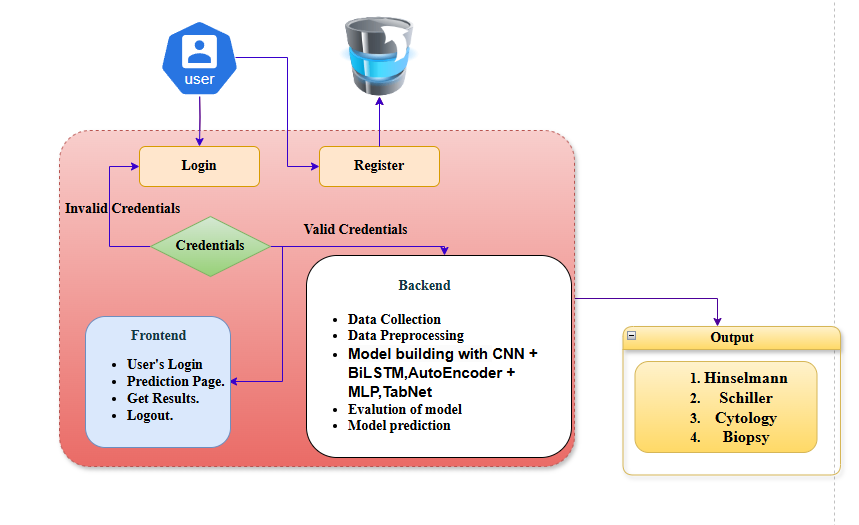
Block Diagram
Specifications
SOFTWARE REQUIREMENS
Operating System : Windows 7/8/10
Server side Script : HTML, CSS, Bootstrap & JS
Programming Language : Python
Libraries Django, Pandas, Torch, Keras, Sklearn, Numpy , Seaborn
IDE/Workbench : VSCode
Server Deployment : Xampp Server
Database : SQLite
HARDWARE REQUIREMENTS
Processor - I3/Intel Processor
RAM - 8GB (min)
Hard Disk - 128 GB
Key Board - Standard Windows Keyboard
Mouse - Two or Three Button Mouse
Monitor - Any

Demo Video


Request for Video
 Paper Publishing
Request Call Back
Would you like to receive a free callback now?
Choose the best time for callback:
Leave your message and we will contact you as soon as possible

6-2-85/B, Old Maternity Hospital Road, Thyagaraja Nagar, Tirupati, Andhra Pradesh – 517501
+91 9030333433
+91 9393939065
0877-2261612

Disclaimer - Takeoff Edu Group Projects are not associated or affiliated with IEEE in any way. The IEEE Projects mentioned here are mentioned in the context of student projects, whose ideas are derived from IEEE publications, not projects of or by IEEE.

