Bi-directional Li-fi Communication For Transmitting Data, Audio Information Using Arduino
Abstract
This project presents a prototype of a bi-directional Li-Fi (Light Fidelity) communication system for transmitting both data and audio signals using Arduino-based microcontrollers. Li-Fi, a high-speed wireless communication system using visible light, offers an efficient alternative to traditional radio-frequency communication. In this implementation, data and audio signals are modulated onto light emitted by an LED at the transmitter end and received by a photodiode at the receiver end. The system enables real-time two-way communication by integrating two pairs of transmitter-receiver modules, allowing simultaneous exchange of information. Arduino microcontrollers are used to encode, transmit, receive, and decode the signals. This prototype demonstrates the feasibility of low-cost, short-range Li-Fi communication for applications such as secure indoor networking and smart device interaction.
Keywords: LI-FI, bi-directional Li-Fi (Light Fidelity) communication, Arduino UNO.
NOTE: Without the concern of our team, please don't submit to the college. This Abstract varies based on student requirements.
Block Diagram
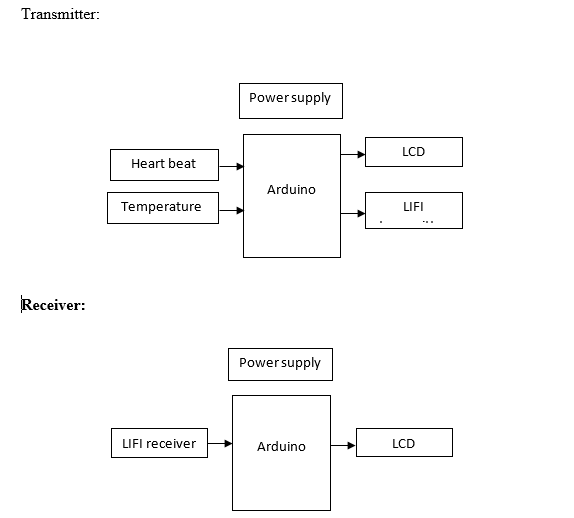
Specifications
Hardware components:
· Heart beat sensor
· Temperature Sensor
· LCD
· Lifi module
· Audio amplifier
· speaker
Software components:
· Arduino IDE
· Embedded c
Learning Outcomes
- Understand the Arduino uno microcontroller pin diagram and architecture.
- Learn how to install and set up the necessary development environment for Arduino uno.
- Get acquainted with software tools for Arduino uno programming.
- Develop basic coding skills for the Arduino uno microcontroller.
- Explore the functionality of lifi module.
- Learn about the power supply requirements for the Arduino and connected components.
- About Project Development Life Cycle:
- Planning and Requirement Gathering( software’s, Tools, Hardware components, etc.,)
- Schematic preparation
- Code development and debugging
- Hardware development and debugging
- Development of the Project and Output testing
- Practical exposure to:
- Hardware and software tools.
- Solution providing for real time problems.
- Working with team/ individual.
- Work on Creative ideas.
- Project development Skills
- Problem analyzing skills
- Problem solving skills
- Creativity and imaginary skills
- Programming skills
- Deployment
- Testing skills
- Debugging skills
- Project presentation skills
- Thesis writing skills


 Paper Publishing

Request Call Back
Would you like to receive a free callback now?
Choose the best time for callback:
Leave your message and we will contact you as soon as possible

6-2-85/B, Old Maternity Hospital Road, Thyagaraja Nagar, Tirupati, Andhra Pradesh – 517501
+91 9030333433
+91 9393939065
0877-2261612

Disclaimer - Takeoff Edu Group Projects are not associated or affiliated with IEEE in any way. The IEEE Projects mentioned here are mentioned in the context of student projects, whose ideas are derived from IEEE publications, not projects of or by IEEE.

