Bi-directional Li-fi Communication For Transmitting Data, Audio Information Using Arduino
Also Available Domains WSN|Embedded applications
Abstract
This project demonstrates a dual-function LiFi (Light Fidelity) communication system capable of transmitting both text and audio signals using visible light. The system comprises two separate kits: a LiFi transmitter and a LiFi receiver, each built using Arduino microcontrollers. On the transmitter side, an LCD display and a 3.5mm jack are integrated, enabling the system to send textual data serially and audio signals through connected earphones. The text is transmitted using modulated LED light, while the audio signal is directly coupled into the light signal. On the receiver side, a photodiode captures the incoming light signal, which is then decoded by the Arduino. The received text is displayed on an LCD screen, while the audio signal is filtered and amplified to be played through a speaker. This project showcases the potential of LiFi technology as an alternative wireless communication method for short-range, secure, and interference-free transmission of both digital and analog data, highlighting its application in modern communication systems.
NOTE: Without the concern of our team, please don't submit to the college. This Abstract varies based on student requirements.
Block Diagram
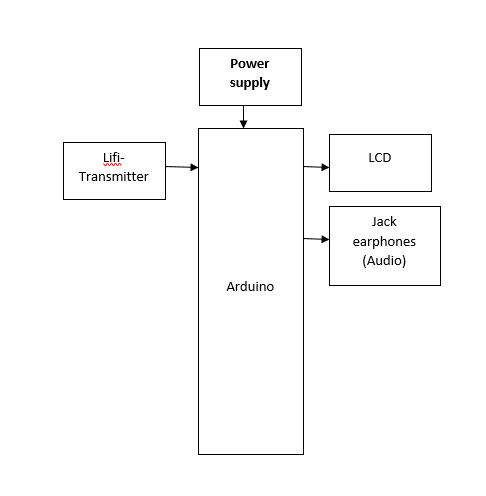
Specifications
Hardware requirements:
- Arduino
- Lifi-Trasnmitter and receiver
- LCD
- Jack earphones
- Speakers
- Power supply
Software requirements:
- Arduino IDE
- Embedded C
Learning Outcomes
- Arduino Pin diagram and Architecture
- How to install Arduino IDE Software
- Setting up and Installation procedures for Arduino IDE
- Introduction to Arduino IDE
- Commands in Embedded C
- How to install Libraries?
- Basic coding in Embedded C
- Working of Lifi-transmitter and reciver
- How to interface Lifi with Arduino?
- Working of Speakers
- Working of LCD
- How to interface LCD with Arduino?
- About Project Development Life Cycle:
- Planning and Requirement Gathering (software’s, Tools, Hardware components, etc.,)
- Schematic preparation
- Code development and debugging
- Hardware development and debugging
- Development of the Project and Output testing
- Practical exposure to:
- Hardware and software tools.
- Solution providing for real time problems.
- Working with team/ individual.
- Work on Creative ideas.
- Project development Skills
- Problem analyzing skills
- Problem solving skills
- Creativity and imaginary skills
- Programming skills
- Deployment
- Testing skills
- Debugging skills
- Project presentation skills
- Thesis writing skills


 Paper Publishing

Request Call Back
Would you like to receive a free callback now?
Choose the best time for callback:
Leave your message and we will contact you as soon as possible

6-2-85/B, Old Maternity Hospital Road, Thyagaraja Nagar, Tirupati, Andhra Pradesh – 517501
+91 9030333433
+91 9393939065
0877-2261612

Disclaimer - Takeoff Edu Group Projects are not associated or affiliated with IEEE in any way. The IEEE Projects mentioned here are mentioned in the context of student projects, whose ideas are derived from IEEE publications, not projects of or by IEEE.

