Benchmarking Machine Learning Algorithms for Bearing Fault Classification Using Vibration Data – A Deployment-Oriented Study
Objective
This project focuses on comparing and benchmarking multiple machine learning algorithms for bearing fault classification using vibration signal data. The system extracts time-domain and frequency-domain features to evaluate models such as SVM, Random Forest, XGBoost, and Neural Networks. The deployment-oriented approach emphasizes real-world applicability, accuracy, and computational efficiency, supporting predictive maintenance and early fault diagnosis in industrial systems.
Abstract
The paper presents a deployment-oriented study for bearing fault classification using vibration data collected from rotating machinery. The proposed framework aims to benchmark machine learning algorithms for identifying various fault types in bearing systems, a crucial task for predictive maintenance in industrial settings. The study leverages a Random Forest model for classification, trained on features extracted from vibration signals, such as statistical metrics (mean, standard deviation, skewness, kurtosis) and frequency-domain features (crest factor, root mean square). This paper also compares the performance of multiple algorithms, including XGBoost, MLP (Multilayer Perceptron), and CNN (Convolutional Neural Networks), based on accuracy and computational efficiency. The framework is implemented in a Flask web application that allows users to upload vibration data in CSV format, interact with the classification model, and receive predictions with confidence scores. MySQL is employed for user management and data storage. The system is designed to be scalable, user-friendly, and capable of being deployed for real-time fault detection in industrial applications. The study highlights the effectiveness of ensemble models such as Random Forest and XGBoost for fault classification, while also considering the practical aspects of model deployment and ease of use in industrial settings.
Keywords:
Bearing
fault classification, vibration data, machine learning algorithms, Random
Forest, XGBoost, MLP, CNN, Flask web application, predictive maintenance,
MySQL, industrial applications.
NOTE: Without the concern of our team, please don't submit to the college. This Abstract varies based on student requirements.
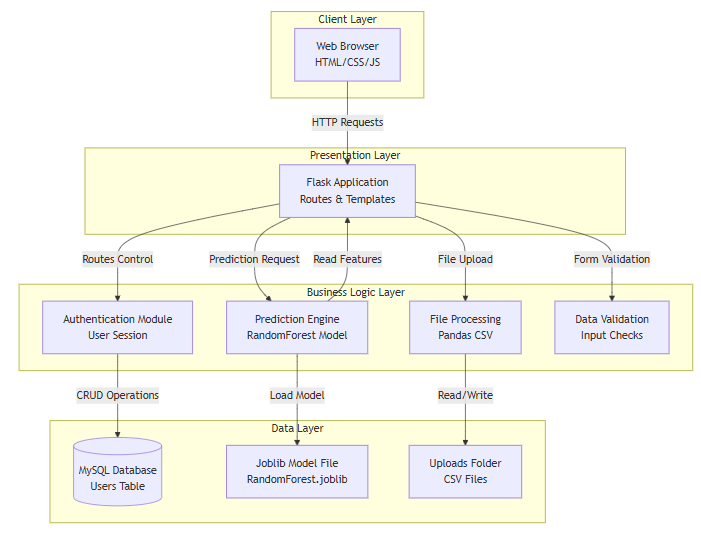
Block Diagram
Specifications
SOFTWARE REQUIREMENS
Operating System : Windows 7/8/10
Server side Script : HTML, CSS, Bootstrap & JS
Programming Language : Python
Libraries : Flask, Pandas, Torch, Keras, Sklearn,Numpy , Seaborn
IDE/Workbench : VSCODE
Server Deployment : Xampp Server
Database : MySQL
HARDWARE REQUIREMENTS
Processor - I3/Intel Processor
RAM - 8GB (min)
Hard Disk - 128 GB
Key Board - Standard Windows Keyboard
Mouse - Two or Three Button Mouse
Monitor - Any

Demo Video


Request for Video
 Paper Publishing
Request Call Back
Would you like to receive a free callback now?
Choose the best time for callback:
Leave your message and we will contact you as soon as possible

6-2-85/B, Old Maternity Hospital Road, Thyagaraja Nagar, Tirupati, Andhra Pradesh – 517501
+91 9030333433
+91 9393939065
0877-2261612

Disclaimer - Takeoff Edu Group Projects are not associated or affiliated with IEEE in any way. The IEEE Projects mentioned here are mentioned in the context of student projects, whose ideas are derived from IEEE publications, not projects of or by IEEE.

