Beam Prediction Based on Large Language Models
Objective
This project focuses on predicting beamforming patterns in wireless communication systems using Large Language Models (LLMs). Traditional beam prediction methods often rely on exhaustive search or complex signal processing techniques, which can be time-consuming and computationally intensive. By leveraging the pattern recognition and sequence modeling capabilities of LLMs, the system can analyze historical and real-time channel data to predict optimal beam directions efficiently. This approach enhances signal quality, reduces latency, and improves overall network performance. The model enables smarter, faster, and more adaptive beam management, contributing to the advancement of next-generation wireless communication systems like 5G and beyond.
Abstract
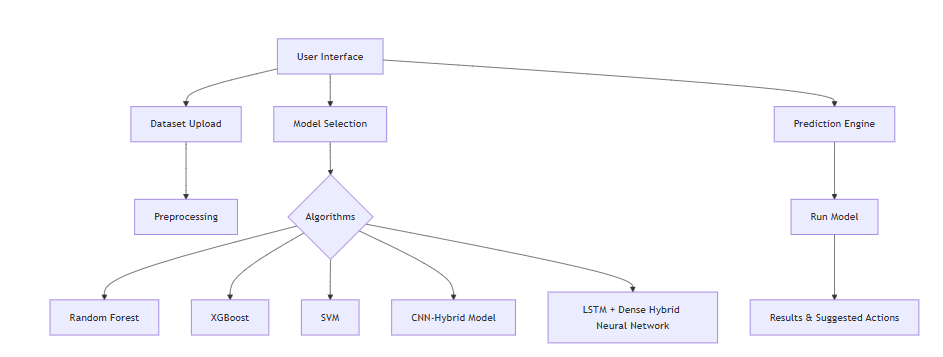
Beam Prediction Based on Large Language Models aims to develop a smart system that predicts the optimal beam for satellite antenna steering based on user input data. This system integrates machine learning models, such as Random Forest (RF), XGBoost, SVM, and hybrid deep learning models like CNN-Hybrid and LSTM + Dense Hybrid Neural Network, to analyze historical user location and beam data, providing accurate predictions on the most suitable beam direction. The CNN-Hybrid model extracts high-level features, while the LSTM + Dense Hybrid Neural Network captures sequential dependencies, enhancing the model's ability to make predictions over time. A Flask-based web application allows users to upload data, select algorithms, and receive real-time feedback. By leveraging large language models (LLMs) and probabilistic descriptions, the system generates intuitive explanations of beam predictions, offering users clear insights into the likelihood of optimal performance. This project serves as a proof of concept for applying LLMs in beam prediction, providing a scalable and efficient solution for satellite management and optimization, with an accessible user interface for satellite communications.
Keywords: Beam Prediction, Large Language Models, Satellite Antenna, Machine Learning, Random Forest, XGBoost, SVM, CNN-Hybrid Model, LSTM + Dense Hybrid Neural Network, Flask, Data Upload, Prediction Accuracy, Probabilistic Description, User Interaction, Satellite Communications, System Optimization.
NOTE: Without the concern of our team, please don't submit to the college. This Abstract varies based on student requirements.
Block Diagram
Specifications
SOFTWARE REQUIREMENS
· Operating System: Windows 7/8/10 or Linux (Ubuntu 18.04+)
· Frontend Technologies: HTML, CSS, Bootstrap, JavaScript
· Programming Language: Python 3.8+
· Deep Learning Libraries: TensorFlow/Keras, OpenCV, NumPy, Pandas
· Additional Libraries: Flask (for web server), Pillow (for image handling), Scikit-learn (for preprocessing), Matplotlib/Seaborn (for visualization, if needed)
· IDE/Workbench: Visual Studio Code (VSCode) or PyCharm
· Server Deployment: Flask Development Server / XAMPP (for MySQL management)
· Database: MySQL (for user authentication and log storage)
· IoT Integration Support: MQTT/HTTP Protocols for smart surveillance deployment
HARDWARE REQUIREMENTS
· Processor: Intel i5 or higher (Quad-core recommended)
· RAM: 8GB minimum (16GB recommended for large-scale real-time processing)
· Storage (Hard Disk/SSD): 128GB+ (preferably SSD for faster read/write operations)
· Keyboard: Standard Windows/Mac Keyboard
· Mouse: Two or Three Button Optical Mouse
· Monitor: Any standard HD display (Full HD recommended for live monitoring)

Demo Video


Request for Video
 Paper Publishing
Request Call Back
Would you like to receive a free callback now?
Choose the best time for callback:
Leave your message and we will contact you as soon as possible

6-2-85/B, Old Maternity Hospital Road, Thyagaraja Nagar, Tirupati, Andhra Pradesh – 517501
+91 9030333433
+91 9393939065
0877-2261612

Disclaimer - Takeoff Edu Group Projects are not associated or affiliated with IEEE in any way. The IEEE Projects mentioned here are mentioned in the context of student projects, whose ideas are derived from IEEE publications, not projects of or by IEEE.

