BASIC IOT NETWORK AND INTRUSION DETECTION
Objective
To establish a comprehensive framework for IoT networks, delineating the architecture, components, communication models, and interactions among IoT devices. This framework aims to address the challenges of scalability, interoperability, and efficient data exchange inherent in IoT environments.
Abstract
The burgeoning integration of Internet of Things (IoT) technologies into everyday life has been met with a parallel increase in security vulnerabilities, prompting the necessity for robust intrusion detection systems (IDS) tailored for IoT networks. This research presents an exploration into the establishment of a fundamental IoT network framework, alongside the development and implementation of an effective IDS designed to mitigate the unique security challenges faced by such network. The paper begins by delineating the architecture of a basic IoT network, highlighting its components, communication models, and the typical interactions between various IoT devices. Given the diverse and often resource-constrained nature of these devices, the network architecture is designed to support scalability, interoperability, and efficient data exchange.Subsequently, the focus shifts to the realm of security, underlining the paramount importance of safeguarding these interconnected systems against malicious intrusions. The paper introduces a novel IDS specifically engineered for IoT environments, leveraging cutting-edge techniques such as machine learning algorithms and behavioral analysis to identify and respond to anomalous activities indicative of potential security breaches
Keywords: lineardiscriminantanalysis, mlpclassifier, k-nearestneighbours, logisticRegression, Decisiontree
NOTE: Without the concern of our team, please don't submit to the college. This Abstract varies based on student requirements.
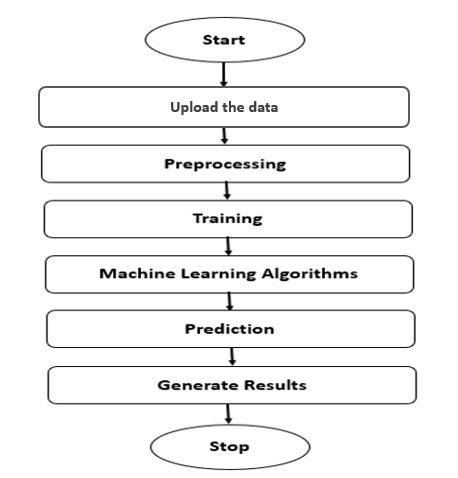
Block Diagram
Specifications
H/W Configuration:
Operating system : Windows 7 or 7+
RAM : 8 GB
Hard disc or SSD : More than 500 GB
Processor : Intel 3rd generation or high or Ryzen with 8 GB Ram
S/W Configuration:
Software’s : Python 3.6 or high version
IDE : PyCharm.
Framework : Flask, pandas, numpy and Scikit-Learn


 Paper Publishing

Request Call Back
Would you like to receive a free callback now?
Choose the best time for callback:
Leave your message and we will contact you as soon as possible

6-2-85/B, Old Maternity Hospital Road, Thyagaraja Nagar, Tirupati, Andhra Pradesh – 517501
+91 9030333433
+91 9393939065
0877-2261612

Disclaimer - Takeoff Edu Group Projects are not associated or affiliated with IEEE in any way. The IEEE Projects mentioned here are mentioned in the context of student projects, whose ideas are derived from IEEE publications, not projects of or by IEEE.

