Automatic Fault Detection and Location of Transmission Lines using IoT
Also Available Domains Electrical
Objective
The main objective is to find the fault in the transmission lines and alerting the authorization through IOT that at which wire the fault occurred along with its location
Abstract
The Electric Power System is divided into many different sections. One of which is the transmission system, where power is transmitted from generating stations and substations via transmission lines into consumers. Both methods could encounter various types of malfunctions is usually referred to as a “Fault”. Fault is simply defined as a number of undesirable but unavoidable incidents can temporarily disturb the stable condition of the power system that occurs when the insulation of the system fails at any point.
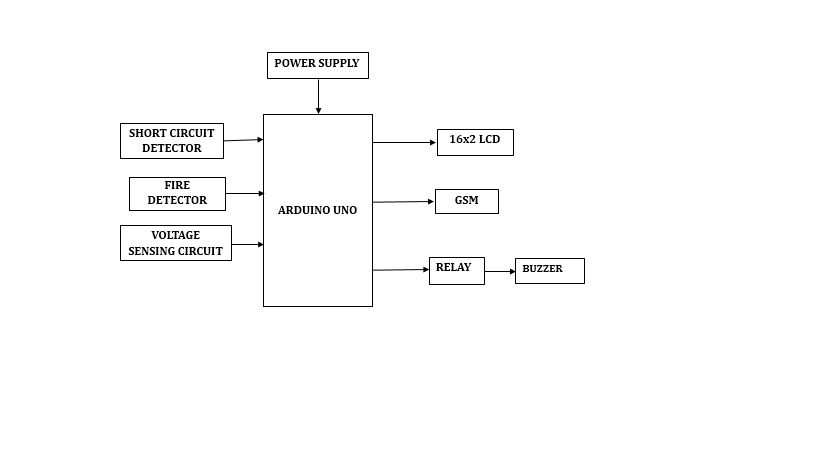
A smart GSM based fault detection and location system was used to adequately and accurately indicate and locate the fault had occurred. This will ensure a shorter response time for technical crew to rectify these faults and thus help save transformers from damage and disasters. The system uses a current transformer, a voltage transformer, arduino, short circuit detector, voltage sensing circuit (for over load cases), and a GSM modem. The system automatically detect faults, analyses and classifies these faults and then, calculates the fault distance from the control room using an impedance-based algorithm method.
Finally, the fault information is transmitted to the control room. In conclusion, the time required to locate a fault is drastically reduced, as the system automatically and accurately provides accurate fault location information. By using this project, we can detect the faults of three phase transmission lines one can monitor the Temperature, Voltage, Current by means of GSM modem by sending message.
Keywords: Short circuit detector, Fire detector, Arduino uno.
NOTE: Without the concern of our team, please don't submit to the college. This Abstract varies based on student requirements.
Block Diagram
Specifications
Hardware Requirements:
- Arduino uno
- Short circuit detector
- Voltage sensing device
- 16x2 LCD
- Relay
- Buzzer
- GSM
- Fire detector
- Power supply
Software Requirements:
- Arduino IDE
- Embedded C
- Fritzing
Learning Outcomes
- Arduino UNO Pin diagram and Architecture
- How to install arduino IDE Software
- Setting up and Installation procedures for Arduino UNO
- Introduction to Arduino IDE
- Commands in Arduino
- How to install Libraries?
- Basic coding in Embedded C
- Working of fire detector
- How to interface fire detector with arduino?
- Working of voltage sensing circuit
- How to interface voltage sensing circuit with arduino?
- Working of short circuit detector
- How to interface short circuit detector with arduino
- Working of LCD
- Working of relay
- Introduction to Serial Communication
- Working of GSM
- How to interface relay, LCD, GSM with arduino?
- About Project Development Life Cycle:
- Planning and Requirement Gathering( software’s, Tools, Hardware components, etc.,)
- Schematic preparation
- Code development and debugging
- Hardware development and debugging
- Development of the Project and Output testing
- Practical exposure to:
- Hardware and software tools.
- Solution providing for real time problems.
- Working with team/ individual.
- Work on Creative ideas.
- Project development Skills
- Problem analyzing skills
- Problem solving skills
- Creativity and imaginary skills
- Programming skills
- Deployment
- Testing skills
- Debugging skills
- Project presentation skills
- Thesis writing skills


 Paper Publishing

Request Call Back
Would you like to receive a free callback now?
Choose the best time for callback:
Leave your message and we will contact you as soon as possible

6-2-85/B, Old Maternity Hospital Road, Thyagaraja Nagar, Tirupati, Andhra Pradesh – 517501
+91 9030333433
+91 9393939065
0877-2261612

Disclaimer - Takeoff Edu Group Projects are not associated or affiliated with IEEE in any way. The IEEE Projects mentioned here are mentioned in the context of student projects, whose ideas are derived from IEEE publications, not projects of or by IEEE.

