Automated SMS-Based Vaccination Reminder System for Child Health Management
Objective
To design and implement an automated system that sends timely SMS alerts to parents or guardians reminding them about their children’s upcoming and missed vaccination schedules, thereby improving immunization compliance, reducing dropouts, and ensuring better child health management.
Abstract
Child vaccination is one of the most effective methods for preventing infectious diseases and ensuring healthy growth. However, missed vaccination appointments due to lack of awareness or forgetfulness remain a significant challenge for parents and healthcare providers. This paper presents an Automated SMS-Based Vaccination Reminder System for Child Health Management that integrates vaccination scheduling, health monitoring, and notification services into a single platform. The proposed system utilizes an Arduino microcontroller as the central controller, interfaced with a Real-Time Clock (RTC) module to maintain accurate vaccination schedules. Push buttons are provided to set and update vaccination dates, while an LCD displays system information and appointment details.In addition to vaccination management, the system continuously monitors the child's vital parameters, including body temperature using a temperature sensor, heart rate using a heartbeat sensor, and blood oxygen saturation (SpO₂) using a pulse sensor. If any abnormal health condition is detected, a buzzer is activated to provide an immediate alert. A GSM module is employed to send automated SMS notifications to parents or guardians. Reminder messages are transmitted prior to the scheduled vaccination date, and confirmation messages are sent once the vaccination process is completed. By combining real-time health monitoring with automated vaccination reminders, the proposed system aims to improve vaccination compliance, enhance child healthcare management, and reduce the risk of missed immunization schedules. The system offers a cost-effective, reliable, and user-friendly solution suitable for home and primary healthcare environments.
NOTE: Without the concern of our team, please don't submit to the college. This Abstract varies based on student requirements.
Block Diagram
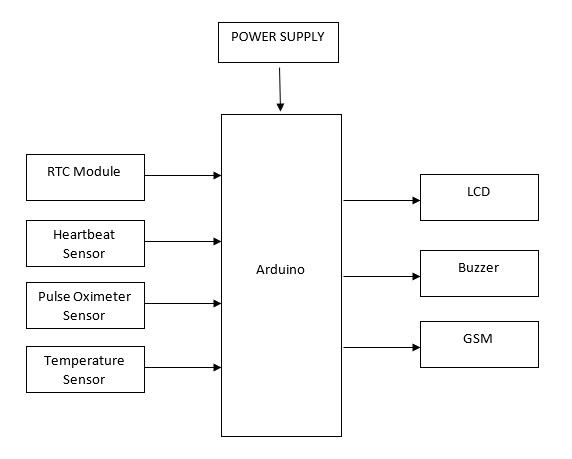
Specifications
Hardware components:
- Arduino Uno
- GSM Module
- RTC Module
- LCD Display
- Heartbeat Sensor
- Pulse Oximeter Sensor
- Temperature Sensor
- Push Buttons (3)
- Buzzer
- Power Supply
- 12V Adapter
- Connectors – 30
Software components:
- Embedded C
- Arduino IDE
Learning Outcomes
- Arduino pin diagram and architecture
- How to install Arduino IDE and required software
- Setting up and installation procedure for Arduino IDE
- Introduction to Arduino development environment
- Basics of Embedded C / Python programming
- Basics of IoT platforms
- Working of power supply
- About Project Development Life Cycle:
- Planning and Requirement Gathering (software’s, tools, hardware components, etc.,)
- Schematic preparation
- Code development and debugging
- Hardware development and debugging
- Development of the Project and Output testing
- Practical exposure to:
- Hardware and software tools
- Solution providing for real-time problems
- Working with team / individual
- Work on creative ideas
- Project development Skills:
- Problem analyzing skills
- Problem solving skills
- Creativity and imaginary skills
- Programming skills
- Deployment
- Testing skills
- Debugging skills
- Project presentation skills
- Thesis writing skills


 Paper Publishing

Request Call Back
Would you like to receive a free callback now?
Choose the best time for callback:
Leave your message and we will contact you as soon as possible

6-2-85/B, Old Maternity Hospital Road, Thyagaraja Nagar, Tirupati, Andhra Pradesh – 517501
+91 9030333433
+91 9393939065
0877-2261612

Disclaimer - Takeoff Edu Group Projects are not associated or affiliated with IEEE in any way. The IEEE Projects mentioned here are mentioned in the context of student projects, whose ideas are derived from IEEE publications, not projects of or by IEEE.

