Automated River Floating Debris Detection Using Advanced YOLO Models
Objective
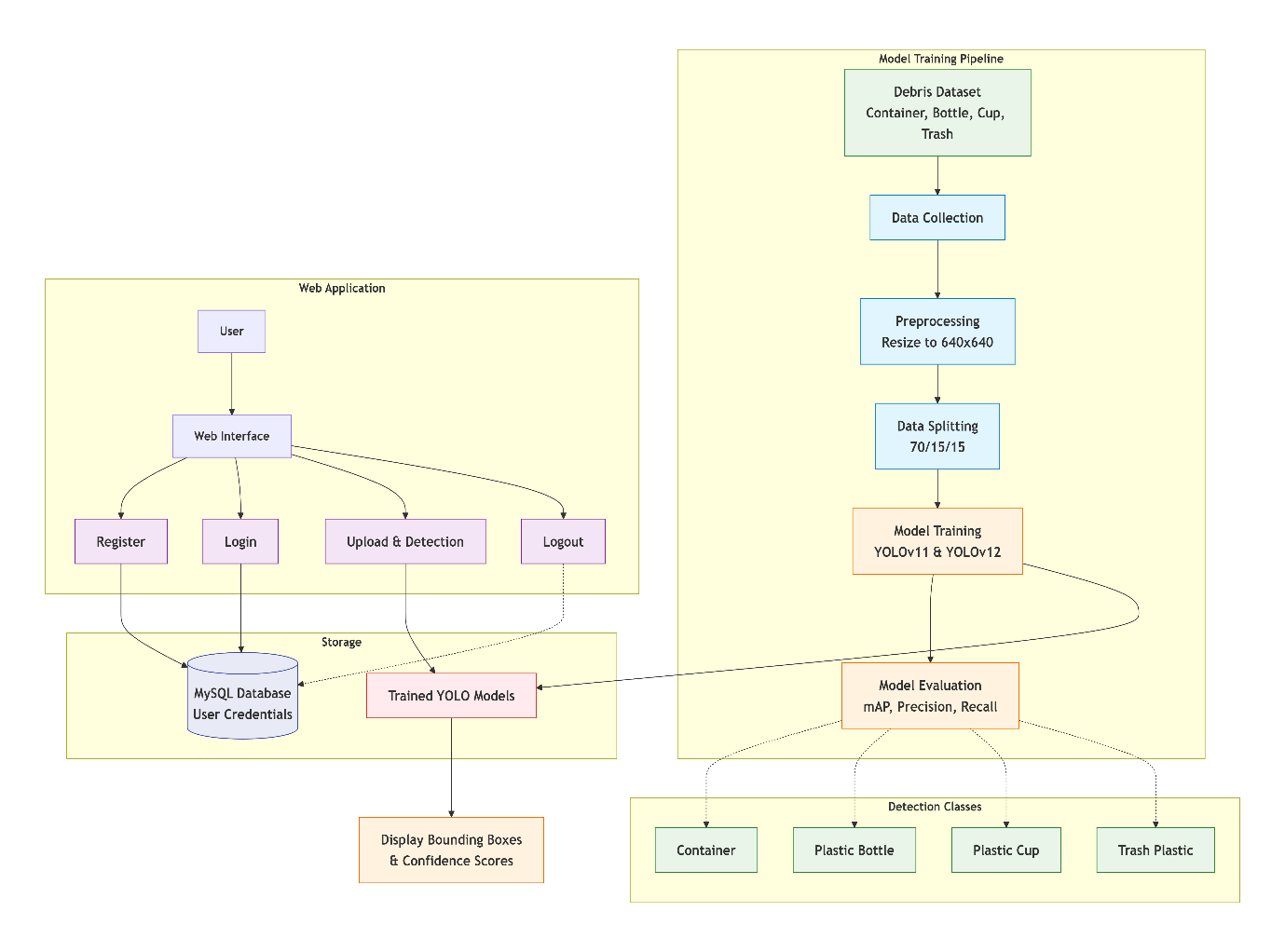
This project develops an advanced object detection system to identify floating plastic debris in rivers using YOLOv11 and YOLOv12. The model detects four plastic pollutants: 'container', 'plastic bottle', 'plastic cup', and 'trash_plastic'. Evaluation using precision, recall, and mAP determined the best balance of accuracy and inference speed for real-world conditions. A Flask-based web application with secure user login allows image uploads for debris detection and visualization. This solution integrates deep learning with web technology for scalable environmental monitoring and waste management.
Abstract
River pollution from floating debris, particularly plastics, poses a severe threat to aquatic ecosystems and human health, demanding efficient automated detection for timely intervention. This project develops an advanced object detection system tailored for identifying floating debris in river environments using state-of-the-art YOLO variants, specifically YOLOv11 and YOLOv12. The model is trained to accurately detect four primary classes: 'container', 'plastic bottle', 'plastic cup', and 'trash_plastic', which represent the most common plastic pollutants in waterways. Comprehensive evaluation was conducted using key performance metrics including precision, recall, and mean Average Precision (mAP) to determine the optimal model balancing accuracy and inference speed in challenging real-world river conditions. A user-friendly web application was built using Flask as the backend framework, complemented by modern CSS and JavaScript for enhanced interactivity and aesthetics. The platform features secure user registration and login, enabling authenticated users to upload river images for debris detection and visualization. This integrated solution bridges cutting-edge deep learning with accessible web technology, supporting scalable environmental monitoring and sustainable waste management efforts.
Keywords
object detection, river floating debris, plastic pollution, YOLOv11, YOLOv12, model evaluation, deep learning, Flask web application, user authentication, image classification, computer vision, environmental monitoring, waste management.
NOTE: Without the concern of our team, please don't submit to the college. This Abstract varies based on student requirements.
Block Diagram
Specifications
1. SOFTWARE REQUIREMENS
Operating System : Windows 7/8/10
Server-side Script : HTML, CSS, Bootstrap & JS
Programming Language : Python
Libraries : Flask, Pandas, Sklearn,Pytorch,Torchvision NumPy, Seaborn, Matplotlib,Ultralytics
IDE/Workbench : VSCode
Technology : Python 3.8+
Server Deployment : Xampp Server
Database : MySQL
2. HARDWARE REQUIREMENTS
Processor - I5/Intel Processor
RAM - 8GB+ (min)
Hard Disk - 128 GB+
Key Board - Standard Windows Keyboard
Mouse - Two or Three Button Mouse
Monitor - Any


 Paper Publishing

Request Call Back
Would you like to receive a free callback now?
Choose the best time for callback:
Leave your message and we will contact you as soon as possible

6-2-85/B, Old Maternity Hospital Road, Thyagaraja Nagar, Tirupati, Andhra Pradesh – 517501
+91 9030333433
+91 9393939065
0877-2261612

Disclaimer - Takeoff Edu Group Projects are not associated or affiliated with IEEE in any way. The IEEE Projects mentioned here are mentioned in the context of student projects, whose ideas are derived from IEEE publications, not projects of or by IEEE.

