Automated Inventory Management System Using Raspberry Pi and Python
Project Code :TEMBMA3594
Objective
To automate and optimize inventory management by integrating Raspberry Pi with RFID, GSM, and LCD technologies for real-time stock monitoring and alerts.
Abstract
The "Inventory Optimization System Using
Raspberry Pi and Python" is an innovative solution designed to streamline
inventory management processes by utilizing modern technology. The system
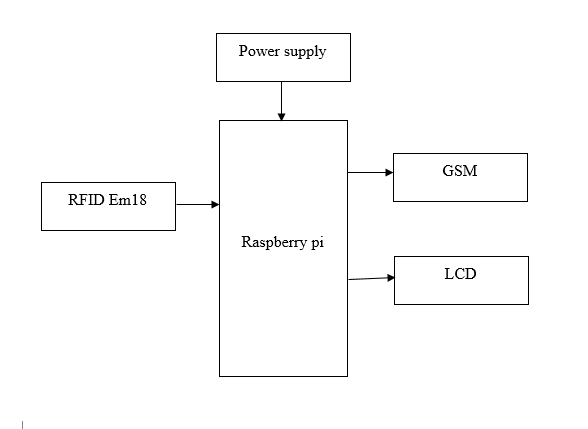
incorporates a Raspberry Pi as the central processing unit, interfacing with an
RFID EM18 reader, GSM module, and an LCD display to provide a comprehensive and
efficient approach to stock monitoring. When an RFID card is swiped over the
EM18 reader, the system records the transaction and updates the inventory count
in an Excel sheet, decreasing the quantity of the corresponding product. This
update ensures that inventory levels are accurately maintained without manual
intervention. The LCD display provides immediate feedback on the transaction,
enhancing user experience. In scenarios where stock levels reach critical low
points, the GSM module automatically sends alert messages to the stock manager,
facilitating proactive restocking and preventing potential out-of-stock
situations. This feature ensures that businesses can maintain optimal inventory
levels, reducing the risk of lost sales due to unavailable products. Additionally,
the system is capable of handling stock replenishment efficiently. Once
products are restocked, inventory levels are updated in the system, maintaining
a seamless flow of information. This automation not only optimizes inventory
management but also minimizes human errors, saves time, and enhances overall
operational efficiency
NOTE: Without the concern of our team, please don't submit to the college. This Abstract varies based on student requirements.
Block Diagram
Specifications
Hardware requirements:
- Raspberry pi
- RFID EM18
- LCD
- GSM
- Power supply
Software requirements:
- Python idle
Learning Outcomes
- Raspberry pi Pin diagram and Architecture
- How to install and setting up of Python IDE
- Basic python coding
- EM 18 interface with Raspberry pi
- GSM interface with Raspberry pi
- LCD interface with Raspberry pi
- About Project Development Life Cycle:
- Planning and Requirement Gathering( software’s, Tools, Hardware components, etc.,)
- Schematic preparation
- Code development and debugging
- Hardware development and debugging
- Development of the Project and Output testing
- Practical exposure to:
- Hardware and software tools. ,
- Solution providing for real time problems,
- Working with team/ individual,
- Work on Creative ideas.
- Project development Skills
- Problem analyzing skills
- Problem solving skills
- Creativity and imaginary skills
- Programming skills
- Deployment
- Testing skills
- Debugging skills
- Project presentation skills
- Thesis writing skills


Related Topics
 Paper Publishing

Request Call Back
Would you like to receive a free callback now?
Choose the best time for callback:
Leave your message and we will contact you as soon as possible

6-2-85/B, Old Maternity Hospital Road, Thyagaraja Nagar, Tirupati, Andhra Pradesh – 517501
+91 9030333433
+91 9393939065
0877-2261612

Disclaimer - Takeoff Edu Group Projects are not associated or affiliated with IEEE in any way. The IEEE Projects mentioned here are mentioned in the context of student projects, whose ideas are derived from IEEE publications, not projects of or by IEEE.

