Automated Chest X-Ray Image Classification Using Manta Ray Optimization with Deep Learning Approach
Objective
The objective of developing an automated chest X-ray image classification system using Manta Ray Optimization (MRO) with a deep learning approach is to improve the accuracy and efficiency of diagnosing various thoracic conditions from chest X-ray images. The system aims to assist healthcare professionals by automatically classifying X-ray images into different categories, aiding in early detection and timely treatment of respiratory and cardiac diseases.
Abstract
Automated chest X-ray image classification is a critical tool for efficient and timely diagnosis of various pulmonary conditions. In this study, we propose a novel approach utilizing Manta Ray Optimization (MRO) in conjunction with state-of-the-art deep learning architectures, specifically Mobile Net and ResNet, for enhanced accuracy in classifying chest X-ray images.
Mobile Net and ResNet are popular deep learning architectures known for their efficiency and high performance in image classification tasks. We leverage the strengths of Mobile Net and ResNet, integrating them with Manta Ray Optimization, an evolutionary algorithm inspired by the movement patterns of manta rays. The MRO algorithm helps optimize the model parameters and enhance the convergence speed during the training process, ultimately improving the classification accuracy.
We conducted experiments on a well-curated chest X-ray dataset and compared the performance of our proposed approach with traditional deep learning methods. The results demonstrate superior classification accuracy and efficiency achieved by the combined MRO and deep learning approach. The incorporation of Manta Ray Optimization significantly enhances the convergence speed, enabling quicker and more accurate diagnoses of chest X-ray images. Our approach holds great promise in revolutionizing automated chest X-ray image classification, aiding healthcare professionals in timely and precise diagnosis of respiratory ailments.
Keywords: deep learning, mobile net, resnet-50, image processing, chest x-rays.
NOTE: Without the concern of our team, please don't submit to the college. This Abstract varies based on student requirements.
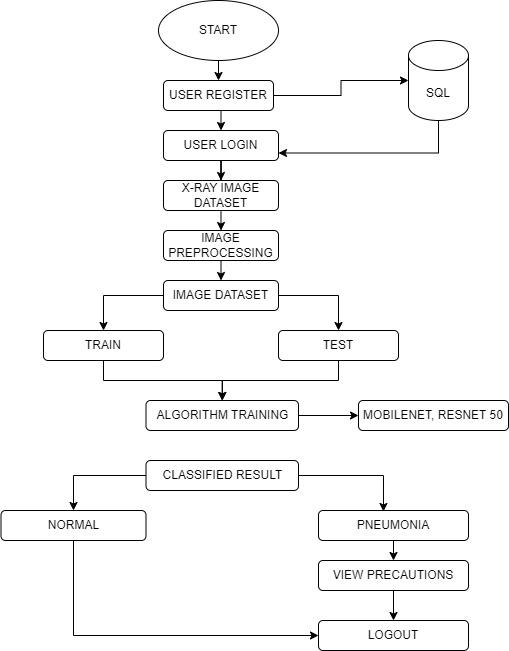
Block Diagram
Specifications
H/W CONFIGURATION:
Processor - I3/Intel Processor
Hard Disk - 160GB
Key Board - Standard Windows Keyboard
Mouse - Two or Three Button Mouse
Monitor - SVGA
RAM - 8GB
S/W CONFIGURATION:
• Operating System : Windows 7/8/10
• Server side Script : HTML, CSS, Bootstrap & JS
• Programming Language : Python
• Libraries : Flask, Pandas, MySQL. Connector, Os, Smtplib, NumPy
• IDE/Workbench : PyCharm
• Technology : Python 3.6+
• Server Deployment : Xampp Server


 Paper Publishing

Request Call Back
Would you like to receive a free callback now?
Choose the best time for callback:
Leave your message and we will contact you as soon as possible

6-2-85/B, Old Maternity Hospital Road, Thyagaraja Nagar, Tirupati, Andhra Pradesh – 517501
+91 9030333433
+91 9393939065
0877-2261612

Disclaimer - Takeoff Edu Group Projects are not associated or affiliated with IEEE in any way. The IEEE Projects mentioned here are mentioned in the context of student projects, whose ideas are derived from IEEE publications, not projects of or by IEEE.

