Automated Apple Leaf Disease Identification with Object Detection Techniques
Objective
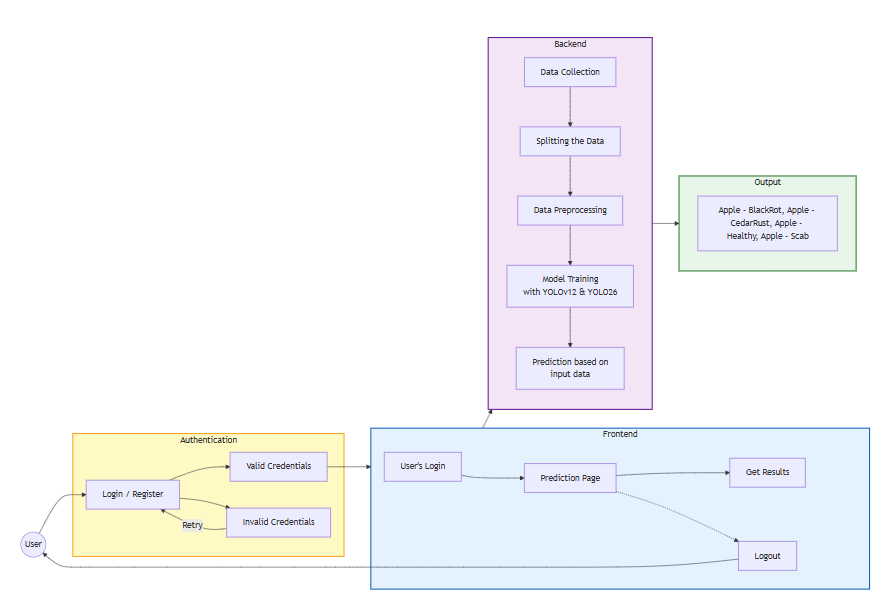
The main objective of this project is to develop an automated system capable of accurately detecting and classifying apple leaf diseases from images. The system aims to collect and prepare a comprehensive dataset of apple leaf images representing various disease types to ensure effective model training and evaluation. Advanced object detection models, specifically YOLOv12 and YOLO26, are implemented and optimized to identify diseased regions within the leaves while providing clear classification labels with confidence scores. A user-friendly web interface is designed using HTML, CSS, and JavaScript to allow seamless image uploads, disease detection, and result visualization. The backend, developed with Python Flask, manages image processing, model inference, and response delivery efficiently. The system is also designed to identify multiple diseases in a single leaf image and to provide accurate metrics such as precision, recall, and F1-score for performance evaluation. Additionally, the framework is modular and scalable, allowing future expansion to include new diseases or plant species without major redesigns. By achieving these objectives, the project aims to deliver an accessible, reliable, and scalable solution for automated plant disease monitoring, supporting informed decision-making and effective crop management.
Abstract
Accurate identification of leaf diseases is crucial for maintaining healthy crops and ensuring sustainable agriculture. Manual detection methods are often time-consuming, inconsistent, and dependent on expert knowledge. To overcome these limitations, advanced object detection algorithms have been employed for automated disease identification. This project leverages convolutional neural networks-based detection frameworks to analyze images of apple leaves and classify various disease types. By integrating two cutting-edge object detection models, the system efficiently detects infected regions, categorizes the diseases, and provides visual outputs highlighting affected areas. Extensive experimentation demonstrates improved detection accuracy and robustness across varying leaf patterns and lighting conditions. The approach reduces reliance on human expertise, provides scalable disease monitoring, and supports informed decision-making in crop management. The system’s architecture combines a web-based interface with image processing capabilities, allowing users to upload leaf images and receive disease identification results through a responsive platform. Experimental results indicate that the detection models achieve high precision, recall, and overall performance, validating the effectiveness of automated object detection in plant disease analysis. This methodology lays the foundation for further enhancements in precision agriculture and intelligent crop monitoring.
Keywords: Apple leaf, Disease detection, Object detection, YOLOv12, YOLOv26, Image classification, Leaf segmentation, Agricultural automation, Deep learning, Computer vision.
NOTE: Without the concern of our team, please don't submit to the college. This Abstract varies based on student requirements.
Block Diagram
Specifications
Hardware Requirements
Processor - I3/Intel Processor
Hard Disk - 160GB
Key Board - Standard Windows Keyboard
Mouse - Two or Three Button Mouse
Monitor - SVGA
RAM - 8GB
Software Requirements:
Operating System : Windows 7/8/10
Server side Script : HTML, CSS, Bootstrap & JS
Programming Language : Python
Libraries : Flask/Django, Pandas, Mysql.connector, Os, Smtplib, Numpy
IDE/Workbench : PyCharm
Technology : Python 3.6+
Server Deployment : Xampp Server
Database : MySQL

Demo Video


Request for Video
 Paper Publishing
Request Call Back
Would you like to receive a free callback now?
Choose the best time for callback:
Leave your message and we will contact you as soon as possible

6-2-85/B, Old Maternity Hospital Road, Thyagaraja Nagar, Tirupati, Andhra Pradesh – 517501
+91 9030333433
+91 9393939065
0877-2261612

Disclaimer - Takeoff Edu Group Projects are not associated or affiliated with IEEE in any way. The IEEE Projects mentioned here are mentioned in the context of student projects, whose ideas are derived from IEEE publications, not projects of or by IEEE.

