Artificial Flora Algorithm-Based Feature Selection with Support Vector Machine for Cardiovascular Disease Classification
Objective
The primary objective of this project is to design and implement a robust machine learning-based classification system for cardiovascular disease (CVD) detection and severity assessment using an optimized feature selection mechanism. Specifically, the project aims to integrate the Artificial Flora Algorithm (AFA) for selecting the most relevant features from medical and behavioral data inputs, which include age, gender, chest pain type, fasting blood sugar, heart rate, and slope of the ST segment. These features will be used to predict not just the presence of heart disease, but also its severity level—categorized into normal, mild, moderate, and severe.
Abstract
Cardiovascular diseases (CVDs) remain the leading cause of mortality globally, contributing to approximately 18 million deaths every year, according to the World Health Organization (WHO). Despite advancements in healthcare technologies, the early diagnosis and accurate prediction of heart diseases continue to pose significant challenges due to the multifactorial nature and complexity of the disease. Traditional diagnostic methods such as clinical assessments, invasive procedures, and physician expertise are often limited by resource constraints, especially in underdeveloped regions. With the rise of artificial intelligence and machine learning in healthcare, data-driven models have shown great potential to assist in the early detection of heart disease by analyzing clinical and physiological data. Machine learning models, especially classification algorithms, can uncover complex patterns within medical datasets that traditional statistical methods might miss. This motivates the development of robust and intelligent predictive systems capable of supporting healthcare professionals in clinical decision-making.
In this study, an automated system for cardiovascular disease classification is proposed, leveraging Support Vector Machine (SVM) as the primary classifier. To enhance the feature selection process and improve the prediction accuracy, the Artificial Flora Algorithm (AFA) is utilized. AFA is a powerful optimization technique inspired by the natural propagation behavior of plants, which enables the selection of the most relevant features from patient data, reducing noise and improving model efficiency. Further improvements are achieved through the incorporation of ensemble methods such as the Stacking Classifier, Adaboost, combining Random Forest models tuned with Particle Swarm Optimization (PSO), to enhance robustness and generalization.
Keyword: Cardiovascular Disease Classification, Heart Disease Prediction, Artificial Flora Algorithm, Support Vector Machine, Feature Selection, Ensemble Learning, Random Forest, Particle Swarm Optimization, Stacking Classifier, Clinical Data Analysis.
NOTE: Without the concern of our team, please don't submit to the college. This Abstract varies based on student requirements.
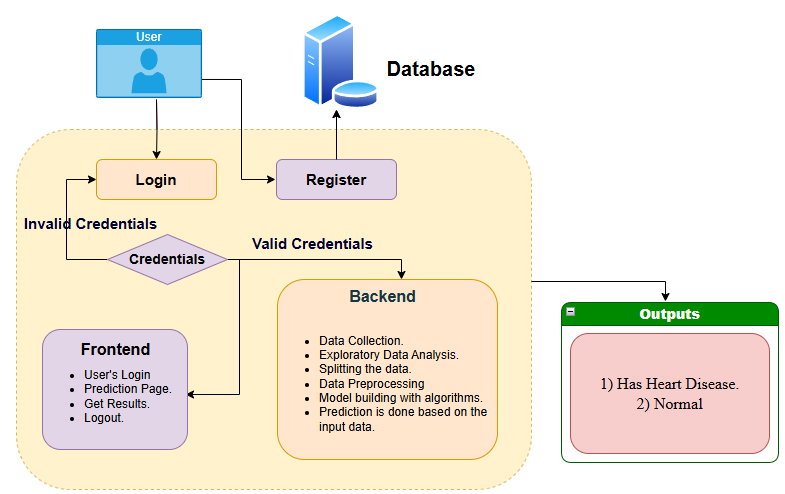
Block Diagram
Specifications
Hardware Requirements
Processor - I3/Intel Processor
Hard Disk - 160GB
Key Board - Standard Windows Keyboard
Mouse - Two or Three Button Mouse
Monitor - SVGA
RAM - 8GB
Software Requirements:
Operating System : Windows 7/8/10
Server side Script : HTML, CSS, Bootstrap & JS
Programming Language : Python
Libraries : Flask/Django, Pandas, Mysql.connector, Os, Smtplib, Numpy
IDE/Workbench : PyCharm
Technology : Python 3.6+
Server Deployment : Xampp Server
Database : MySQL


 Paper Publishing

Request Call Back
Would you like to receive a free callback now?
Choose the best time for callback:
Leave your message and we will contact you as soon as possible

6-2-85/B, Old Maternity Hospital Road, Thyagaraja Nagar, Tirupati, Andhra Pradesh – 517501
+91 9030333433
+91 9393939065
0877-2261612

Disclaimer - Takeoff Edu Group Projects are not associated or affiliated with IEEE in any way. The IEEE Projects mentioned here are mentioned in the context of student projects, whose ideas are derived from IEEE publications, not projects of or by IEEE.

