APPLICATION OF ARTIFICIAL INTELLIGENCE IN TINNITUS DIAGNOSIS AND TREATMENT A PILOT STUDY
Objective
The objective of this project is to develop an AI-based multi-label classification system for the accurate diagnosis of tinnitus using the Neurofeedback Tinnitus Dataset. It aims to leverage machine learning algorithms such as Random Forest, LightGBM, LSTM, AdaBoost, and XGBoost to effectively identify complex patterns associated with tinnitus. The project also emphasizes model interpretability by incorporating SHAP (SHapley Additive exPlanations), enabling clinicians to understand the rationale behind predictions. This approach supports transparent, personalized treatment strategies and advances the role of explainable AI in auditory healthcare.
Abstract
This pilot study explores the application of Artificial Intelligence (AI) in the diagnosis and treatment of tinnitus, a prevalent auditory disorder, by leveraging advanced machine learning algorithms. Utilizing the Neurofeedback Tinnitus Dataset, the study focuses on developing and optimizing a multi-label classification model for accurate tinnitus diagnosis. Initially, a Random Forest classifier is employed to identify tinnitus-related patterns within the data. To enhance diagnostic accuracy and predictive performance, the study integrates advanced algorithms including LightGBM, Long Short-Term Memory (LSTM) networks, AdaBoost, and XGBoost. These models are selected for their robustness in handling high-dimensional, complex datasets and their proven efficacy in classification tasks. Furthermore, the implementation of SHAP (SHapley Additive exPlanations) provides model interpretability, enabling clinicians to comprehend the underlying rationale behind AI-driven predictions. This explainability fosters greater trust and transparency in clinical decision-making. Overall, the research contributes to the advancement of AI-assisted auditory healthcare, offering a foundation for personalized tinnitus treatment strategies and improved management practices through interpretable machine learning.
Keywords: Artificial Intelligence · Tinnitus Diagnosis · Machine Learning · Random Forest · LightGBM · LSTM · AdaBoost · XGBoost · SHAP · Explainability · Multi-label Classification.
NOTE: Without the concern of our team, please don't submit to the college. This Abstract varies based on student requirements.
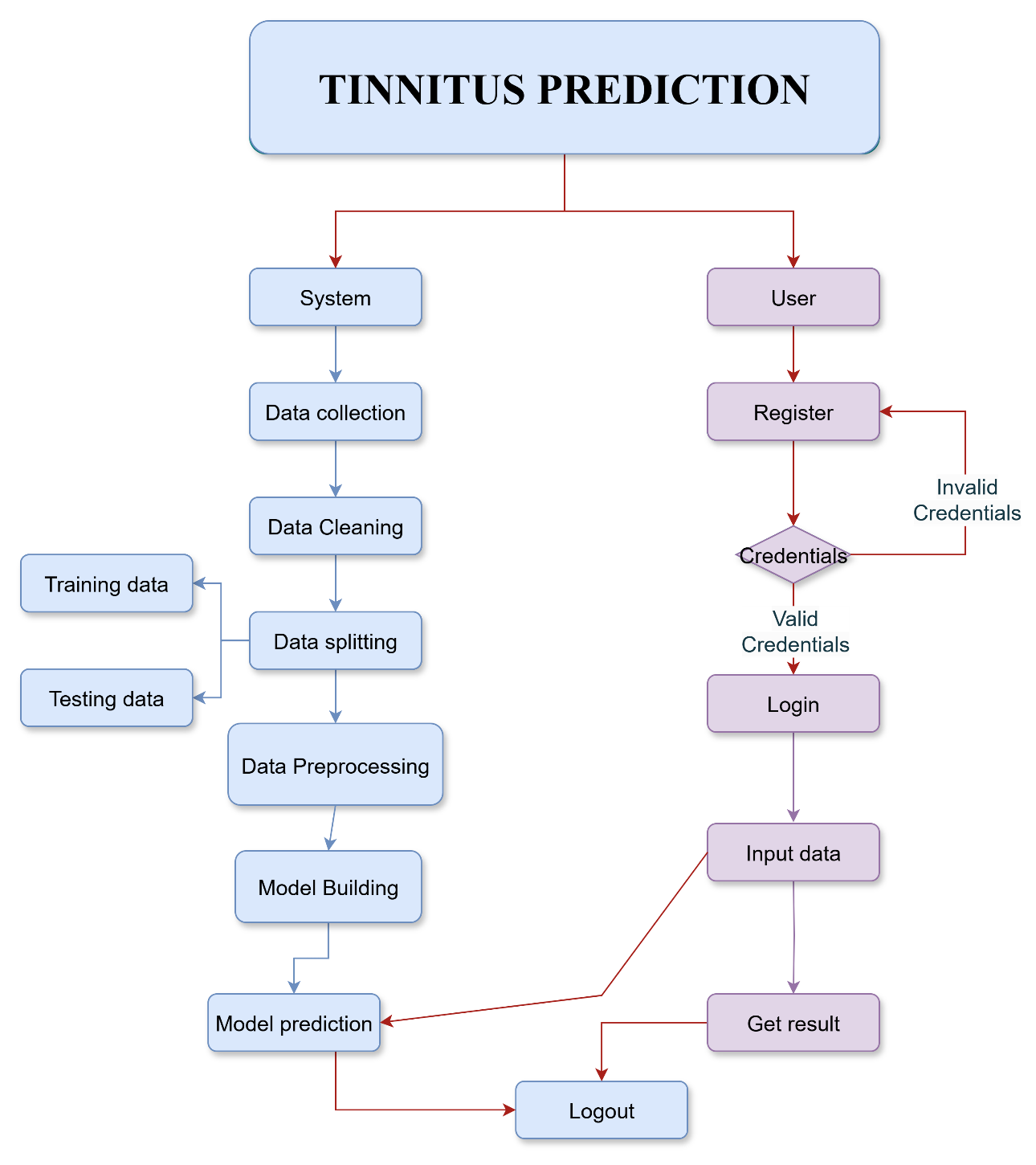
Block Diagram
Specifications
Hardware Requirements:
Processor - I3/Intel Processor
Hard Disk - 160GB
Key Board - Standard Windows Keyboard
Mouse - Two or Three Button Mouse
Monitor - SVGA
RAM - 8GB
Software Requirements:
• Operating System : Windows 7/8/10
• Server side Script : HTML, CSS, Bootstrap & JS
• Programming Language : Python
• Libraries : Flask, Pandas, Mysql.connector, Os, Scikit-learn, Numpy
• IDE/Workbench : PyCharm
• Technology : Python 3.6+
• Server Deployment : Xampp Server


 Paper Publishing

Request Call Back
Would you like to receive a free callback now?
Choose the best time for callback:
Leave your message and we will contact you as soon as possible

6-2-85/B, Old Maternity Hospital Road, Thyagaraja Nagar, Tirupati, Andhra Pradesh – 517501
+91 9030333433
+91 9393939065
0877-2261612

Disclaimer - Takeoff Edu Group Projects are not associated or affiliated with IEEE in any way. The IEEE Projects mentioned here are mentioned in the context of student projects, whose ideas are derived from IEEE publications, not projects of or by IEEE.

