Anticipating Financial Risk Machine Learning for Debt Management in Telecommunications
Objective
This project develops an intelligent credit risk prediction framework that leverages advanced machine learning techniques to classify borrowers as high-risk or low-risk. The system uses Random Forest, Gradient Boosting, Confidence-Weighted Fusion, and TabTransformer to analyze 28 critical financial indicators, including trade history, delinquency patterns, credit utilization, and external risk scores. Random Forest and Gradient Boosting capture complex, nonlinear interactions in financial data, while TabTransformer models feature-level dependencies using attention mechanisms. Confidence-Weighted Fusion combines predictions from all models according to confidence levels, ensuring robust and reliable classification.
Abstract
This work presents a machine learning framework for predicting financial risk and managing debt in the telecommunications sector. The framework integrates Random Forest, Gradient Boosting, TabTransformer, and a Confidence-Weighted Fusion ensemble to capture complex relationships among customer demographics, payment history, usage patterns, and socioeconomic indicators. The dataset is preprocessed through data cleaning, outlier detection, feature engineering, and normalization to ensure robust model training. Random Forest and Gradient Boosting identify nonlinear patterns in customer behavior, while TabTransformer employs attention mechanisms to capture feature-level dependencies in tabular data. The Confidence-Weighted Fusion ensemble combines predictions from all models, assigning higher influence to outputs with greater confidence, thereby improving overall predictive accuracy and generalization. The system classifies customers according to their likelihood of default or delayed payment and evaluates multiple risk scenarios using sensitivity analysis. Experimental results demonstrate that the ensemble consistently outperforms individual models in accuracy, F1-score, and robustness. The proposed framework provides telecommunications providers with a scalable, explainable, and proactive decision-support tool for debt management, enabling early risk detection, optimizing collection strategies, and improving financial sustainability. This approach advances AI-driven financial risk management by integrating ensemble learning, predictive analytics, and scenario modeling into a unified framework for telecommunications debt oversight.
Keywords: Financial Risk, Debt Management, Telecommunications, Random Forest, Gradient Boosting, TabTransformer, Confidence-Weighted Fusion, Ensemble Learning, Predictive Analytics, Scenario Analysis.
NOTE: Without the concern of our team, please don't submit to the college. This Abstract varies based on student requirements.
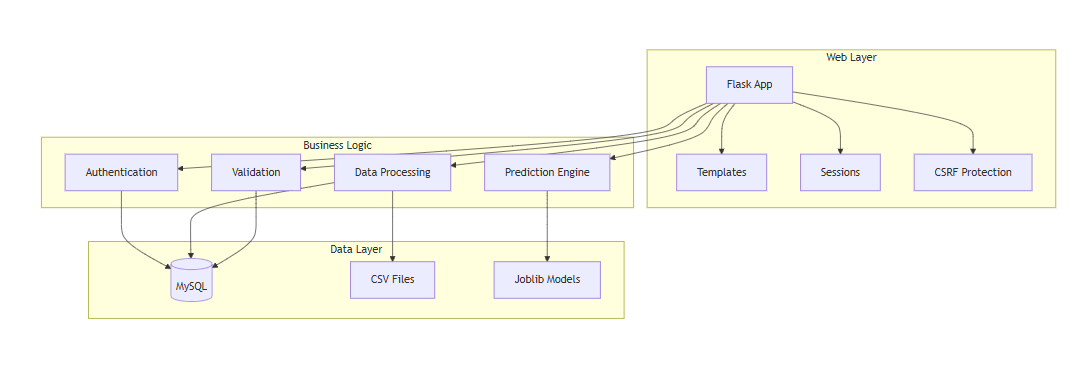
Block Diagram
Specifications
4.1 SOFTWARE REQUIREMENTS
Operating System : Windows 7/8/10
Server side Script : HTML, CSS, Bootstrap & JS
Programming Language : Python
Libraries : Flask, Pandas, Sklearn, Numpy , Seaborn
IDE/Workbench : VSCODE
Server Deployment : Xampp Server
Database : MySQL
4.2 HARDWARE REQUIREMENTS
Processor - I3/Intel Processor
RAM - 8GB (min)
Hard Disk - 128 GB
Keyboard - Standard Windows Keyboard
Mouse - Two or Three Button Mouse
Monitor - Any

Demo Video


Request for Video
 Paper Publishing
Request Call Back
Would you like to receive a free callback now?
Choose the best time for callback:
Leave your message and we will contact you as soon as possible

6-2-85/B, Old Maternity Hospital Road, Thyagaraja Nagar, Tirupati, Andhra Pradesh – 517501
+91 9030333433
+91 9393939065
0877-2261612

Disclaimer - Takeoff Edu Group Projects are not associated or affiliated with IEEE in any way. The IEEE Projects mentioned here are mentioned in the context of student projects, whose ideas are derived from IEEE publications, not projects of or by IEEE.

