ANN Controlled Bidirectional Totem Pole AC-DC Converter with Isolated DAB for High-Efficiency EV Charging
Also Available Domains Electrical Vehicles
Objective
To design and control an ANN-based bidirectional Totem-Pole AC/DC converter integrated with an isolated Dual Active Bridge (DAB) converter for efficient electric vehicle charging and bidirectional power flow operation.
Abstract
Abstract
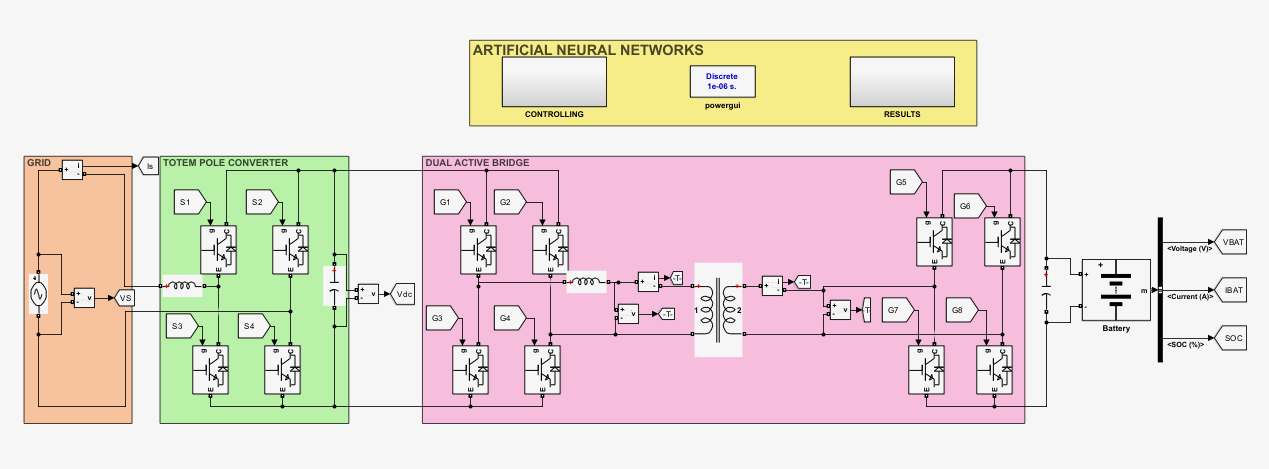
This paper presents the design and control of an ANN-based bidirectional Totem-Pole AC/DC converter integrated with an isolated Dual Active Bridge (DAB) DC-DC converter for high-efficiency electric vehicle (EV) charging applications. The proposed system enables efficient bidirectional power transfer between the AC grid and EV battery through a common DC-link structure. An Artificial Neural Network (ANN) controller is implemented to regulate the DC-link voltage, improve dynamic response, and control power flow under varying operating conditions. The Totem-Pole converter enhances power factor correction and reduces total harmonic distortion by replacing conventional diode bridge rectifiers with high-frequency active switches. The isolated DAB converter provides efficient bidirectional energy transfer and electrical isolation between the DC-link and EV battery. The ANN controller dynamically adjusts the duty cycle and phase shift angle for precise voltage and current regulation. Simulation results under varying load conditions demonstrate improved DC-link voltage stability, reduced harmonic distortion, fast transient response, and enhanced system efficiency compared to conventional PI-controlled systems. The proposed system is highly suitable for fast EV charging stations, smart grid applications, and advanced power electronic systems.
Keywords
Bidirectional Converter, Totem-Pole Converter, Dual Active Bridge (DAB), Artificial Neural Network (ANN), Electric Vehicle Charging, Power Factor Correction (PFC), Total Harmonic Distortion (THD), DC-Link Voltage, MATLAB/Simulink, Smart Grid.
NOTE: Without the concern of our team, please don't submit to the college. This Abstract varies based on student requirements.
Block Diagram
Specifications
Software & Hardware Requirements
Software Configuration:
• Operating System : Windows 7/8/10/11
• Application Software : MATLAB/Simulink
Hardware Configuration:
• RAM : 8 GB Minimum
• Processor : Intel I3 / I5 / I7
• Hard Disk : 250 GB or Above
Learning Outcomes
Learning Outcomes
• Introduction to MATLAB/Simulink
• Study of Bidirectional Power Converters
• Understanding of Totem-Pole AC/DC Converter
• Study of Dual Active Bridge (DAB) Converter
• Introduction to Artificial Neural Network (ANN)
• Design of ANN-based Controller
• Power Factor Correction Techniques
• Harmonic Reduction Techniques
• PWM Pulse Generation Methods
• DC-Link Voltage Regulation
• EV Charging System Design
• Vehicle-to-Grid (V2G) Operation
• Converter Modeling and Simulation
• Dynamic Performance Analysis
• Power Quality Improvement Techniques
Project Development Skills
• MATLAB/Simulink Modeling Skills
• Power Electronics Design Skills
• ANN Controller Development
• Converter Analysis Techniques
• Problem Solving Skills
• Simulation and Testing Skills
• Performance Evaluation Skills
• Debugging Skills
• Research and Thesis Writing Skills
• Technical Documentation Skills
Demo Video


Request for Video
 Paper Publishing
Request Call Back
Would you like to receive a free callback now?
Choose the best time for callback:
Leave your message and we will contact you as soon as possible

6-2-85/B, Old Maternity Hospital Road, Thyagaraja Nagar, Tirupati, Andhra Pradesh – 517501
+91 9030333433
+91 9393939065
0877-2261612

Disclaimer - Takeoff Edu Group Projects are not associated or affiliated with IEEE in any way. The IEEE Projects mentioned here are mentioned in the context of student projects, whose ideas are derived from IEEE publications, not projects of or by IEEE.

