Analysis of the Impact of LFSR Architecture on Accuracy of Stochastic Computing Processors
Objective
Stochastic computing (SC) has emerged as an efficient paradigm for low-power, fault-tolerant processing in neural networks and image processing. SC uses bitstream-based stochastic sequences to represent probabilities, making it inherently resilient to noise and computational errors. However, the accuracy of SC operations depends significantly on the quality of these sequences, typically generated by linear feedback shift registers (LFSRs). This study analyzes the impact of different LFSR architectures—Fibonacci, Galois, and Mixed—on SC accuracy
Abstract
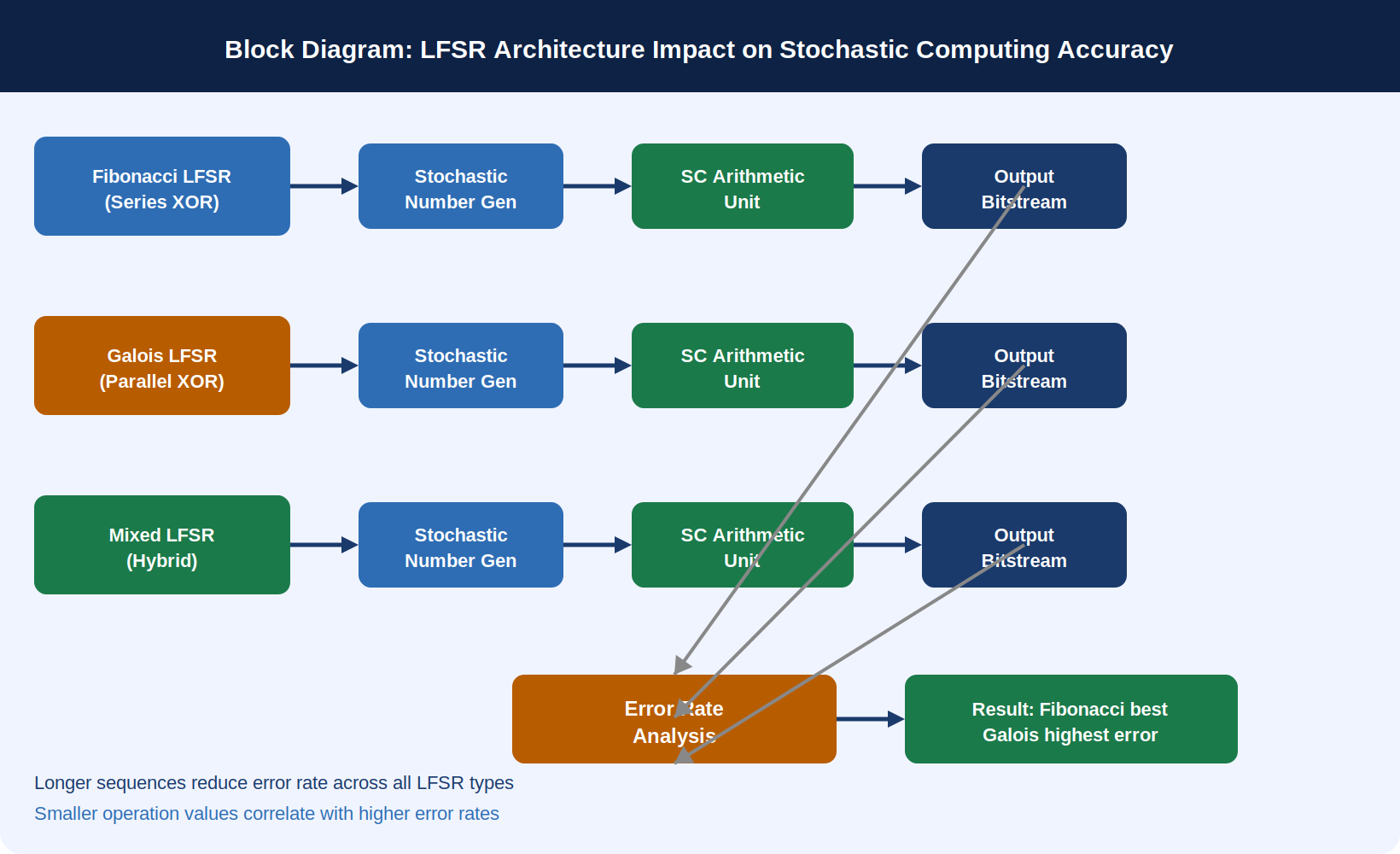
Stochastic computing (SC) has emerged as an efficient paradigm for low-power, fault-tolerant processing in neural networks and image processing. SC uses bitstream-based stochastic sequences to represent probabilities, making it inherently resilient to noise and computational errors. However, the accuracy of SC operations depends significantly on the quality of these sequences, typically generated by linear feedback shift registers (LFSRs). This study analyzes the impact of different LFSR architectures—Fibonacci, Galois, and Mixed—on SC accuracy. Experiments revealed that Fibonacci LFSR achieved the lowest error rate, followed by Mixed and then Galois LFSR, which showed a significantly higher error rate. Additionally, results indicate that increasing the length of the stochastic sequence generally reduces the error rate across all LFSR types, while smaller operation results are associated with higher error rates.
Keywords: Stochastic Computing, LFSR, Fibonacci LFSR, Galois LFSR, Mixed LFSR, Error Rate, Neural Networks, Low Power
NOTE: Without the concern of our team, please don't submit to the college. This Abstract varies based on student requirements.
Block Diagram
Specifications
Software Requirements
• Xilinx Vivado / ISE
• Verilog HDL / ModelSim
Hardware Requirements
• Xilinx FPGA (Spartan / Virtex)
• Logic Analyzer
Learning Outcomes
• Stochastic Computing Fundamentals
• LFSR Architecture Design and Analysis
• Random Number Generation in VLSI
• Accuracy-Area Trade-offs in Approximate Computing
• Low Power Circuit Design Techniques


 Paper Publishing

Request Call Back
Would you like to receive a free callback now?
Choose the best time for callback:
Leave your message and we will contact you as soon as possible

6-2-85/B, Old Maternity Hospital Road, Thyagaraja Nagar, Tirupati, Andhra Pradesh – 517501
+91 9030333433
+91 9393939065
0877-2261612

Disclaimer - Takeoff Edu Group Projects are not associated or affiliated with IEEE in any way. The IEEE Projects mentioned here are mentioned in the context of student projects, whose ideas are derived from IEEE publications, not projects of or by IEEE.

