Analysis of Soil Nutrients and Water Levels Using Internet of Things (IoT) for Different Land Use Options
Objective
The main objective of this project is to check soil parameters and water levels using IoT technology for various land use so that it will be useful for land management practices, increases resource utilization
Abstract
An experiment was conducted to study soil analysis methods (conventional laboratory and a smart soil analyses) on nutrient mining and availability under different lands. The conventional soil test is faced with different challenges and may fail to be effective since it takes more time to get the results and it is difficult to take the regular tests during the single crop life time. Smart soil analyzer was designed, developed and compared with the conventional laboratory soil analysis. Coordinate data (Northings, Eastings and Elevation) of the fifteen (15) Sampling, forty five (45) soil samples were collected at three different depths 0 - 15, 15 – 30 and 30 – 75 cm using soil auger, bulked for different depths, air dried and prepared for laboratory analysis to determine soil N, P, K, pH while developed smart soil analyzer was used to determine the selected soil properties at three different depths. Both the results from the conventional laboratory and smart soil analysis were compared. Values of soil N, P, K, pH and MC obtained showed no significant difference at different depths across the four land use patterns. The developed smart soil analyzer is recommended for the determination of soil, pH, N, P and K.
Keywords: IOT, NPK sensor, PH sensor
NOTE: Without the concern of our team, please don't submit to the college. This Abstract varies based on student requirements.
Block Diagram
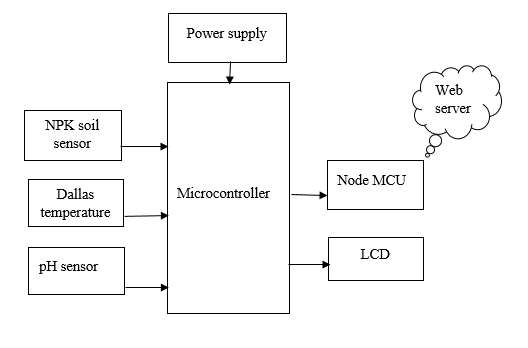
Specifications
Hardware Requirements:
- Arduino
- Dallas Temperature
- PH sensor
- NPK sensor
- Node MCU
- LCD
Software Requirements:
- Arduino IDE
- Embedded C
Learning Outcomes
- Arduino pin diagram and architecture
- How to install Arduino IDE software
- Setting up and installation procedure for Arduino
- Introduction to Arduino IDE
- Basic coding in Arduino IDE
- Working of PH sensor
- Interfacing PH sensor module with Arduino
- Working of power supply
- About Project Development Life Cycle:
- Planning and Requirement Gathering (software’s, Tools, Hardware components, etc.,)
- Schematic preparation
- Code development and debugging
- Hardware development and debugging
- Development of the Project and Output testing
- Practical exposure to:
- Hardware and software tools.
- Solution providing for real time problems.
- Working with team/ individual.
- Work on Creative ideas.
- Project development Skills
- Problem analyzing skills
- Problem solving skills
- Creativity and imaginary skills
- Programming skills
- Deployment
- Testing skills
- Debugging skills
- Project presentation skills


 Paper Publishing

Request Call Back
Would you like to receive a free callback now?
Choose the best time for callback:
Leave your message and we will contact you as soon as possible

6-2-85/B, Old Maternity Hospital Road, Thyagaraja Nagar, Tirupati, Andhra Pradesh – 517501
+91 9030333433
+91 9393939065
0877-2261612

Disclaimer - Takeoff Edu Group Projects are not associated or affiliated with IEEE in any way. The IEEE Projects mentioned here are mentioned in the context of student projects, whose ideas are derived from IEEE publications, not projects of or by IEEE.

