Analysis And Prediction of Crime Hotspots Using Machine Learning with Stacked Generalization Approach
Objective
The objective of Analysis and Prediction of Crime Hotspots Using Machine Learning with Stacked Generalization Approach is to develop a machine learning model that can accurately identify crime hotspots and predict crime occurrences in a given geographic area. The model uses a stacked generalization approach to combine the predictions of multiple base models and improve the accuracy of the overall prediction.
Abstract
Ensemble learning method is a collaborative decision-making mechanism that implements to aggregate the predictions of learned classifiers in order to produce new instances. Early analysis has shown that the ensemble classifiers are more reliable than any single part classifier, both empirically and logically. While several ensemble methods are presented, it is still not an easy task to find an appropriate configuration for a particular dataset. Several prediction-based theories have been proposed to handle machine learning crime prediction problem in India. It becomes a challenging problem to identify the dynamic nature of crimes. Crime prediction is an attempt to reduce crime rate and deter criminal activities. This work proposes an efficient authentic method called assemble-stacking based crime prediction method (SBCPM) based on algorithms for identifying the appropriate predictions of crime by implementing learning-based methods applied to achieve domain-specific configurations compared with another machine learning model. The result implies that a model of a performer does not generally work well. In certain cases, the ensemble model outperforms the others with the highest coefficient of correlation, which has the lowest average and absolute errors. The proposed method achieved classification accuracy on the testing data. The model is found to produce more predictive effect than the previous researches taken as baselines, focusing solely on crime dataset based on violence. The results also proved that any empirical data on crime, is compatible with criminological theories. The proposed approach also found to be useful for predicting possible crime predictions. And suggest that the prediction accuracy of the ensemble model is higher than that of the individual classifier.
Keywords: Decision tree, Random Forest, Gradient Boosting and Machine learning techniques
NOTE: Without the concern of our team, please don't submit to the college. This Abstract varies based on student requirements.
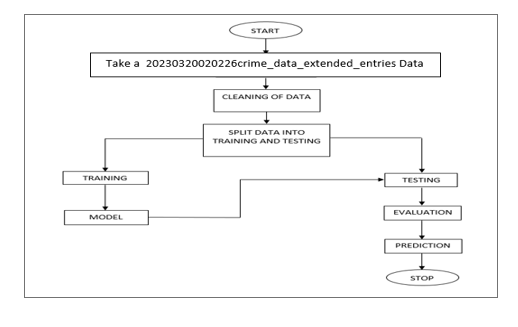
Block Diagram
Specifications
SOFTWARE FRONT END REQUIREMENTS
H/W CONFIGURATION:
Processor- I3/Intel Processor
Hard Disk- Standard Windows Keyboard
Mouse - Two or Three Button Mouse
Monitor - SVGA
RAM - 8GB
S/W CONFIGURATION:
Operating System: Windows 7/8/10
Server side Script: HTML, CSS, Bootstrap & JS
Programming Language: Python
Libraries: Flask, Pandas, Mysql.connector, Os, Smtplib, Numpy
IDE/Workbench: PyCharm
Technology: Python 3.6+
Server Deployment: Xampp Server


 Paper Publishing

Request Call Back
Would you like to receive a free callback now?
Choose the best time for callback:
Leave your message and we will contact you as soon as possible

6-2-85/B, Old Maternity Hospital Road, Thyagaraja Nagar, Tirupati, Andhra Pradesh – 517501
+91 9030333433
+91 9393939065
0877-2261612

Disclaimer - Takeoff Edu Group Projects are not associated or affiliated with IEEE in any way. The IEEE Projects mentioned here are mentioned in the context of student projects, whose ideas are derived from IEEE publications, not projects of or by IEEE.

