Analysis and Anomaly Detection in DWLR Logs using Deep Learning
Objective
This project focuses on the analysis and anomaly detection in Digital Water Level Recorder (DWLR) log data using machine learning and deep learning techniques. Synthetic data is generated to simulate accurate water monitoring conditions, including normal behavior and different anomaly types such as spike, drift, flatline, and outlier. Five key input features—water level, temperature, rainfall, flow rate, and dissolved oxygen—are used for classification. Three models, Random Forest, Artificial Neural Network (ANN), and Long Short-Term Memory (LSTM), are implemented and evaluated to identify anomalies effectively. Random Forest captures feature-based patterns, ANN learns complex non-linear relationships, and LSTM handles temporal dependencies in sequential data. A web-based application is developed using Flask for backend processing and HTML, CSS, and JavaScript for the frontend, including user authentication and result display. The project demonstrates an automated, accurate, and scalable approach for DWLR log analysis and supports reliable water data monitoring.
Abstract
Digital Water Level Recorder (DWLR) systems generate continuous log data that reflects changes in water-related parameters. Analyzing this data is important for identifying unusual behavior that may indicate sensor issues or abnormal conditions. This project focuses on the analysis and anomaly detection in DWLR logs using deep learning and machine learning methods. Synthetic data is used to simulate different patterns and irregularities in water level records. The input features considered in this study include water level, temperature, rainfall, flow rate, and dissolved oxygen. The output is classified into five categories: normal condition, spike, drift, flatline, and outlier. Three algorithms are implemented for classification: Random Forest, Artificial Neural Network (ANN), and Long Short-Term Memory (LSTM). Each model is trained and evaluated to detect anomalies effectively based on the given features. A web-based system is developed using Flask as the backend framework and HTML, CSS, and JavaScript for the frontend. The system includes user authentication and a classification module to display prediction results. This project demonstrates how data-driven models can support accurate anomaly identification in DWLR logs and provides a structured platform for analysis and comparison of different algorithms.
Keywords: DWLR, Anomaly Detection, Synthetic Data, Random Forest, ANN, LSTM, Classification, Deep Learning, Water Data, Flask
NOTE: Without the concern of our team, please don't submit to the college. This Abstract varies based on student requirements.
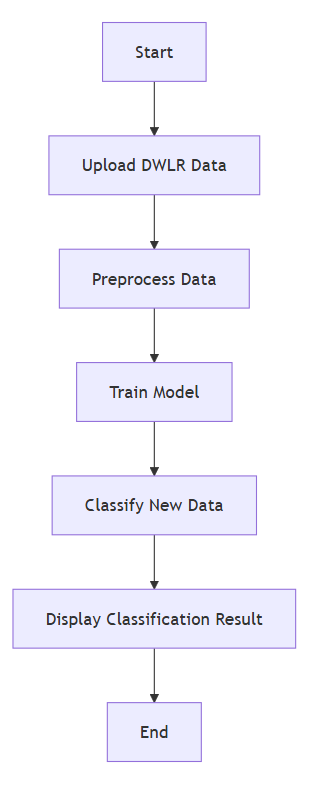
Block Diagram
Specifications
H/W CONFIGURATION:
Processor - I3/Intel Processor
Hard Disk - 160GB
Key Board - Standard Windows Keyboard
Mouse - Two or Three Button Mouse
Monitor - SVGA
RAM - 8GB
S/W CONFIGURATION:
• Operating System : Windows 7/8/10
• Server-side Script : HTML, CSS, Bootstrap & JS
• Programming Language : Python
• Libraries : Flask, Pandas, MySQL. Connector, Scikit-Learn,
• IDE/Workbench : VS Code
• Technology : Python 3.8+
• Server Deployment : Xampp Server


 Paper Publishing

Request Call Back
Would you like to receive a free callback now?
Choose the best time for callback:
Leave your message and we will contact you as soon as possible

6-2-85/B, Old Maternity Hospital Road, Thyagaraja Nagar, Tirupati, Andhra Pradesh – 517501
+91 9030333433
+91 9393939065
0877-2261612

Disclaimer - Takeoff Edu Group Projects are not associated or affiliated with IEEE in any way. The IEEE Projects mentioned here are mentioned in the context of student projects, whose ideas are derived from IEEE publications, not projects of or by IEEE.

