An Optimized Approach for Detecting Osteoporosis Using Machine Learning Algorithms
Objective
The objective of this project is to develop an optimized machine learning-based system for detecting osteoporosis by analyzing lifestyle factors. The system aims to leverage algorithms such as Gradient Boosting, Voting Classifier, Stacking Classifier, and CatBoost to accurately predict the risk of osteoporosis based on demographic and lifestyle data, including age, physical activity, diet, and medical history. The project focuses on preprocessing the dataset to handle missing values, normalize features, and encode categorical variables for effective model training. Additionally, the system will include a user-friendly front-end interface for easy data input and result display, with a back-end built on Python and Flask to manage data processing and model execution. Another key objective is to evaluate and test the system's performance through ensuring the model’s robustness and generalizability. Ultimately, this project aims to provide an accessible, non-invasive, and cost-effective tool for early osteoporosis detection, empowering users to better understand their bone health and take preventive measures.
Abstract
Osteoporosis is a condition that weakens bones, increasing the risk of fractures, and often progresses without noticeable symptoms until it reaches advanced stages. Early detection is essential to manage and prevent further complications. This project aims to develop an optimized approach for detecting osteoporosis using machine learning techniques, leveraging lifestyle factors as input data. The system utilizes algorithms such as Gradient Boosting, Voting Classifier, Stacking Classifier, and CatBoost to predict the risk of osteoporosis based on factors like age, exercise habits, diet, and medical history. The dataset used for the project includes various lifestyle-related features known to influence bone health. The system provides an easy-to-use interface where users can input their data and receive a prediction regarding their osteoporosis risk. The back-end of the system is built using Python and Flask, while the front-end is developed using HTML, CSS, and JavaScript, ensuring a user-friendly experience. By utilizing machine learning models, this project offers a non-invasive and cost-effective method for osteoporosis risk detection, providing individuals with an accessible tool to understand their bone health. The project focuses on optimizing model performance and ensuring high accuracy in predicting osteoporosis risk, contributing to early identification and intervention.
Keywords: osteoporosis, machine learning, Gradient Boosting, Voting Classifier, Stacking Classifier, CatBoost, prediction, lifestyle factors, Python, Flask.
NOTE: Without the concern of our team, please don't submit to the college. This Abstract varies based on student requirements.
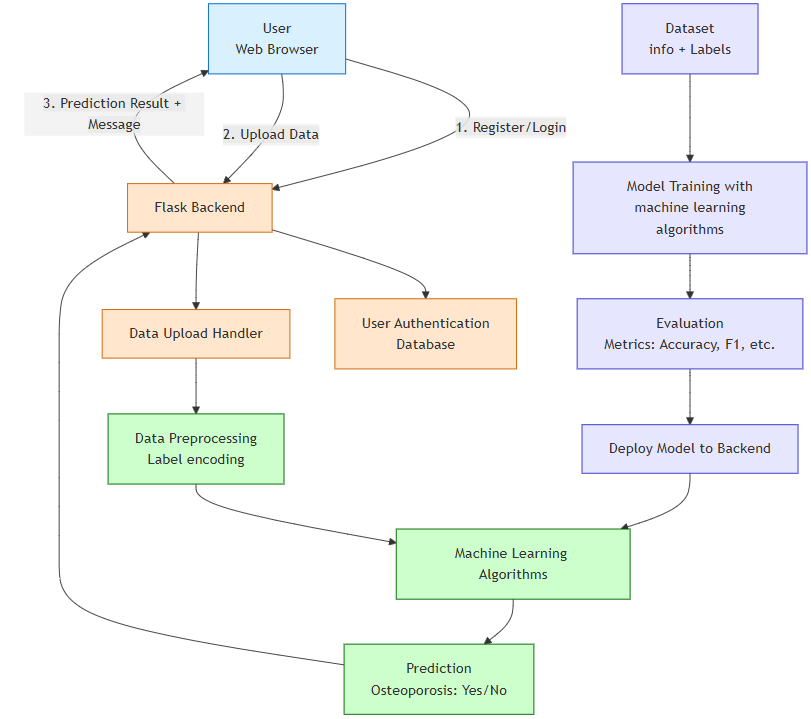
Block Diagram
Specifications
Hardware Requirements
Processor - I3/Intel Processor
Hard Disk - 160GB
Key Board - Standard Windows Keyboard
Mouse - Two or Three Button Mouse
Monitor - SVGA
RAM - 8GB
Software Requirements:
Operating System : Windows 7/8/10
Server side Script : HTML, CSS, Bootstrap & JS
Programming Language : Python
Libraries : Flask/Django, Pandas, Mysql.connector, Os, Numpy
IDE/Workbench : Vscode
Technology : Python 3.6+
Server Deployment : Xampp Server
Database : MySQL


 Paper Publishing

Request Call Back
Would you like to receive a free callback now?
Choose the best time for callback:
Leave your message and we will contact you as soon as possible

6-2-85/B, Old Maternity Hospital Road, Thyagaraja Nagar, Tirupati, Andhra Pradesh – 517501
+91 9030333433
+91 9393939065
0877-2261612

Disclaimer - Takeoff Edu Group Projects are not associated or affiliated with IEEE in any way. The IEEE Projects mentioned here are mentioned in the context of student projects, whose ideas are derived from IEEE publications, not projects of or by IEEE.

