An Iot-Based Covid Patient Health Control System
Objective
The main objective of this project is to develop an IoT-based COVID patient health control system to remotely monitor health data, reducing the risk of viral transmission
Abstract
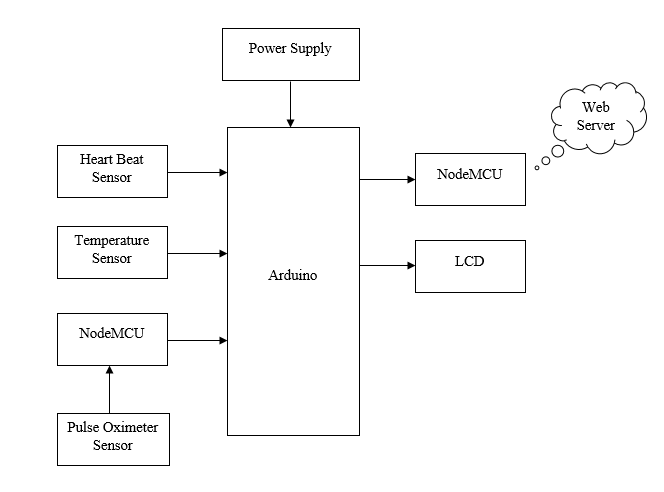
This project aims to develop an Arduino-based system that interfaces with a NodeMCU, a heart rate sensor, and a temperature sensor to monitor a patient's vital signs. The system is designed to facilitate remote monitoring of patients, especially those with COVID-19, by uploading the collected data to a web server. This remote access enables doctors and healthcare professionals to monitor patients' health status without direct contact, ensuring safety and minimizing the risk of infection. And the pulseoximeter read the blood oxygen levels. The Arduino microcontroller acts as the central processing unit, collecting data from the heart rate sensor and temperature sensor. The heart rate sensor measures the patient's pulse rate, while the temperature sensor measures the patient's body temperature. These vital signs are essential indicators for monitoring a patient's health. The NodeMCU, which is a low-cost Wi-Fi enabled microcontroller, serves as the interface between the Arduino and the web server. It establishes a wireless connection with the internet, enabling data transmission to the remote server. The NodeMCU receives the collected data from the Arduino and packages it into a suitable format for uploading.
To enable remote access and data storage, a web server is utilized to receive and store the patient's vital signs. The server provides an interface for doctors and healthcare professionals to access the data remotely, using any internet-enabled device such as a smartphone or computer. This allows medical staff to monitor patients' health status from a safe distance, reducing the risk of transmission. By combining the Arduino, NodeMCU, heart rate sensor, temperature sensor, and web server, this system provides a comprehensive solution for remote patient monitoring.
Keywords: Arduino, NodeMCU, Heart rate sensor, temperature sensor.
NOTE: Without the concern of our team, please don't submit to the college. This Abstract varies based on student requirements.
Block Diagram
Specifications
Hardware Requirements:
- Arduino UNO
- Temperature sensor
- Heartbeat Sensor
- Pulse Oximeter
- Power Supply
- LCD
Software Requirements:
- Arduino IDE
- Embedded C
Learning Outcomes
- Arduino pin diagram and architecture
- How to install Arduino IDE software
- Setting up and installation procedure for Arduino
- Introduction to Arduino IDE
- Basic coding in Arduino IDE
- Working of LCD
- Interface LCD with Arduino
- Working of power supply
- About Project Development Life Cycle
- Planning and Requirement Gathering (software’s, Tools, Hardware components, etc.,)
- Schematic preparation
- Code development and debugging
- Hardware development and debugging
- Development of the Project and Output testing
- Practical exposure to
- Hardware and software tools.
- Solution providing for real time problems.
- Working with team individual.
- Work on Creative ideas.
- Project development Skills
- Problem analyzing skills
- Problem solving skills
- Creativity and imaginary skills
- Programming skills
- Deployment
- Testing skills
- Debugging skills
- Project presentation skills


 Paper Publishing

Request Call Back
Would you like to receive a free callback now?
Choose the best time for callback:
Leave your message and we will contact you as soon as possible

6-2-85/B, Old Maternity Hospital Road, Thyagaraja Nagar, Tirupati, Andhra Pradesh – 517501
+91 9030333433
+91 9393939065
0877-2261612

Disclaimer - Takeoff Edu Group Projects are not associated or affiliated with IEEE in any way. The IEEE Projects mentioned here are mentioned in the context of student projects, whose ideas are derived from IEEE publications, not projects of or by IEEE.

