An Improved Data Procurement Approaches in Wireless Sensor Networks
Objective
This study improves Wireless Sensor Networks by optimizing data acquisition through effective cluster formation and CHIRON protocol.
Abstract
Effective data procurement strategies are critical to maximizing network performance and resource consumption in the context of Wireless Sensor Networks (WSNs). With an emphasis on the crucial stages of network initialization, cluster formation, cluster head selection, route base station establishment, and data gathering using CHIRON (Cluster-Head Initiated Routing Protocol with an ON-demand Gateway in Wireless Sensor Networks), this paper presents an improved method for data acquisition in WSNs. The suggested approach highlights how crucial it is to carefully plan the initialization procedure in order to create a strong network architecture. It then explores the cluster formation mechanism, in which sensors self-organize into clusters, and the cluster heads selection process, in which key nodes are chosen to aggregate data inside their clusters. The study also describes how route base stations are formed, which is important for data relaying from cluster heads to the sink node. Cluster heads are used as data transmission initiators when CHIRON, a dynamic routing protocol designed specifically for WSNs, is implemented. This results in more effective data collecting. By dynamically adjusting to network conditions, CHIRON improves resilience and scalability. In conclusion, the study assesses the effectiveness of the suggested methodology by utilizing significant criteria like data delivery rates, network longevity, and energy consumption. It proves the effectiveness of the enhanced data procurement technique in improving the overall performance of WSNs through simulation and empirical analysis, opening the door for more effective and dependable data gathering in a variety of application scenarios.
Key Words: Wireless Sensor Networks (WSNs), Data Procurement, Cluster Formation, Cluster Head Selection, Route Base Station, CHIRON Protocol, Initialization, Data Gathering.
NOTE: Without the concern of our team, please don't submit to the college. This Abstract varies based on student requirements.
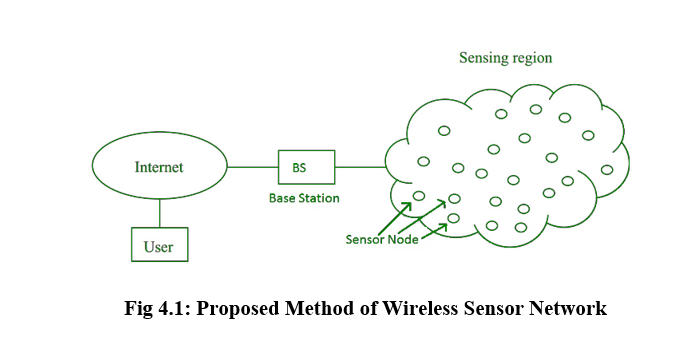
Block Diagram
Specifications
Software: Matlab 2020a or above
Hardware:
Operating Systems:
- Windows 10
- Windows 7 Service Pack 1
- Windows Server 2019
- Windows Server 2016
Processors:
Minimum: Any Intel or AMD x86-64 processor
Recommended: Any Intel or AMD x86-64 processor with four logical cores and AVX2 instruction set support
Disk:
Minimum: 2.9 GB of HDD space for MATLAB only, 5-8 GB for a typical installation
Recommended: An SSD is recommended A full installation of all MathWorks products may take up to 29 GB of disk space
RAM:
Minimum: 4 GB
Recommended: 8 GB
Learning Outcomes
· Introduction to Matlab
· What is EISPACK & LINPACK
· How to start with MATLAB
· About Matlab language
· Matlab coding skills
· About tools & libraries
· Application Program Interface in Matlab
· About Matlab desktop
· How to use Matlab editor to create M-Files
· Features of Matlab
· Basics on Matlab
· What is Communication?
· About Communication
· Introduction to Communication
· How Communication Works?
· Importing the System Design, Characterization and Visualization
· Analyzing of BER tool
· Analyzing of Error Rate Test Console
· Generation of WSN
· WSN network creation
· Nodes Communication
· Clustering
· Routing
· Convolutional
· Equalization and Synchronization etc.,
· How to extend our work to another real time applications
· Project development Skills
o Problem analyzing skills
o Problem solving skills
o Creativity and imaginary skills
o Programming skills
o Deployment
o Testing skills
o Debugging skills
o Project presentation skills
o Thesis writing skills
Demo Video


Request for Video
 Paper Publishing
Request Call Back
Would you like to receive a free callback now?
Choose the best time for callback:
Leave your message and we will contact you as soon as possible

6-2-85/B, Old Maternity Hospital Road, Thyagaraja Nagar, Tirupati, Andhra Pradesh – 517501
+91 9030333433
+91 9393939065
0877-2261612

Disclaimer - Takeoff Edu Group Projects are not associated or affiliated with IEEE in any way. The IEEE Projects mentioned here are mentioned in the context of student projects, whose ideas are derived from IEEE publications, not projects of or by IEEE.

