An Explainable Multi-Level Framework for Cervical Cancer Detection Using Traditional Computer Vision and Deep Learning
Objective
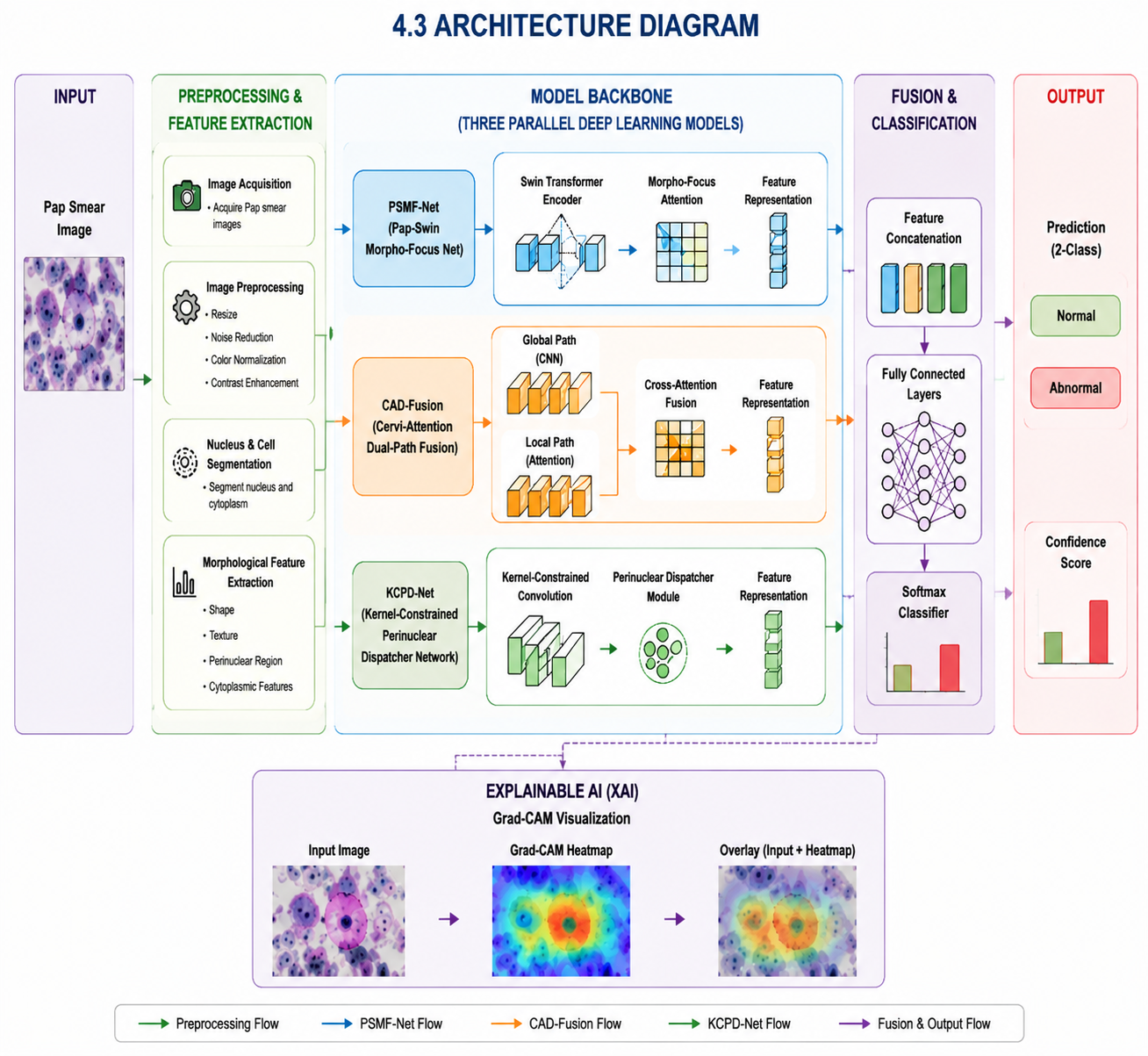
The primary objective of this research is to develop an accurate and explainable automated cervical cancer detection framework using Pap smear images from the SIPAKMED dataset. The study aims to design and evaluate three novel deep learning architectures, namely PSMF Net, CAD Fusion, and KCPD Net, for effective multi-class cervical cell classification. It also focuses on extracting multi-scale morphological and cellular features through advanced attention and feature fusion mechanisms to improve diagnostic performance. Another objective is to enhance model interpretability by integrating Explainable AI techniques such as Grad-CAM and SHAP, enabling visualization of important regions influencing predictions. Furthermore, the research aims to provide a reliable, efficient, and clinically supportive screening system that facilitates early cervical cancer detection and assists healthcare professionals in decision-making.
Abstract
Cervical cancer remains one of the leading causes
of cancer-related mortality among women worldwide, highlighting the need for
accurate and early detection methods. In this study, we propose an explainable
multi-level framework for cervical cancer detection by combining
traditional computer vision techniques with advanced deep learning models. The
framework leverages the SIPAKMED Pap smear dataset, which provides
high-quality annotated images for multi-class classification. Three novel
architectures are developed and evaluated: PSMF‑Net (Pap‑Swin Morpho‑Focus
Net), designed to capture multi-scale morphological features using
EfficientNetV2B3 enhanced with Squeeze-and-Excitation blocks; CAD‑Fusion
(Cervi‑Attention Dual‑Path Fusion), which employs a dual-path attention
mechanism to integrate coarse lesion context and fine cellular details without
computational overhead; and KCPD‑Net (Kernel‑Constrained Perinuclear
Dispatcher Network), which focuses on perinuclear regions with custom
kernel-constrained convolutions to extract fine-grained features. The framework
incorporates pre-processing, multi-level feature extraction, and fusion,
followed by classification into standard Pap smear categories, including.
Explainable AI techniques such as Grad-CAM and SHAP are applied to visualize
the regions contributing to predictions, enhancing interpretability.
Experimental results demonstrate the effectiveness of the proposed models in
capturing relevant morphological patterns and improving classification
accuracy, providing a robust and interpretable solution for automated cervical
cancer screening.
Keywords: Cervical Cancer Detection, Pap Smear, PSMF‑Net, CAD‑Fusion, KCPD‑Net, Explainable AI, Multi-Level Feature Extraction, Deep Learning, Computer Vision.
NOTE: Without the concern of our team, please don't submit to the college. This Abstract varies based on student requirements.
Block Diagram
Specifications
4.1 SOFTWARE REQUIREMENS
Operating System : Windows 7/8/10
Server side Script : HTML, CSS & JS
Programming Language : Python
Libraries : Flask, mysql.connector, os, pandas, torch, torchvision, PIL, matplotlib, sklearn
IDE/Workbench : VSCode
Server Deployment : MYSQL
Database : MySQL
4.2 HARDWARE REQUIREMENTS
Processor - I3/Intel Processor
RAM - 8GB (min)
Hard Disk - 128 GB
Key Board - Standard Windows Keyboard
Mouse - Two or Three Button Mouse
Monitor - Any

Demo Video


Request for Video
 Paper Publishing
Request Call Back
Would you like to receive a free callback now?
Choose the best time for callback:
Leave your message and we will contact you as soon as possible

6-2-85/B, Old Maternity Hospital Road, Thyagaraja Nagar, Tirupati, Andhra Pradesh – 517501
+91 9030333433
+91 9393939065
0877-2261612

Disclaimer - Takeoff Edu Group Projects are not associated or affiliated with IEEE in any way. The IEEE Projects mentioned here are mentioned in the context of student projects, whose ideas are derived from IEEE publications, not projects of or by IEEE.

