An Explainable Deep Learning Network With Transformer and Custom CNN for Bean Leaf Disease Classification
Objective
The objective of this study is to develop an efficient and accurate deep learning-based system for the classification of bean leaf diseases to support smart agriculture practices. Recognizing the limitations of traditional manual inspection methods—which are labor-intensive, costly, and unsuitable for large-scale deployment—this work aims to harness the potential of advanced computer vision techniques to automate disease detection. By leveraging state-of-the-art Convolutional Neural Network (CNN) architectures, specifically DenseNet and MobileNet, the system is designed to accurately classify three key categories of bean plant health: healthy, angular leaf spot, and bean rust. These models are selected for their proven ability to extract intricate features while maintaining computational efficiency, making them ideal for real-time field applications.
Abstract
Keywords Microorganism classification, ResNet, Random Forest, Flask, Hybrid model, Deep learning, CNN, Medical diagnostics, Biological research, Image classification.
NOTE: Without the concern of our team, please don't submit to the college. This Abstract varies based on student requirements.
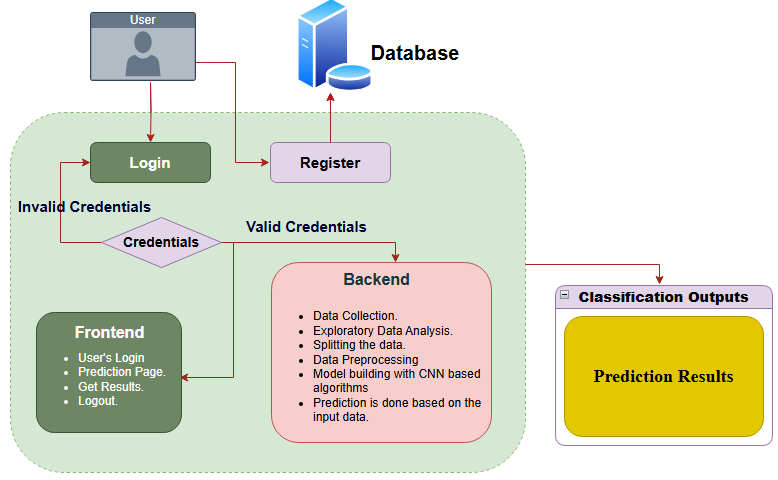
Block Diagram
Specifications
Hardware Requirements
Processor - I3/Intel Processor
Hard Disk - 160GB
Key Board - Standard Windows Keyboard
Mouse - Two or Three Button Mouse
Monitor - SVGA
RAM - 8GB
Software Requirements
• Operating System : Windows 7/8/10
• Programming Language : Python
• Libraries : Pandas, Numpy, scikit-learn.
• IDE/Workbench : Visual Studio Code.

Demo Video


Request for Video
 Paper Publishing
Request Call Back
Would you like to receive a free callback now?
Choose the best time for callback:
Leave your message and we will contact you as soon as possible

6-2-85/B, Old Maternity Hospital Road, Thyagaraja Nagar, Tirupati, Andhra Pradesh – 517501
+91 9030333433
+91 9393939065
0877-2261612

Disclaimer - Takeoff Edu Group Projects are not associated or affiliated with IEEE in any way. The IEEE Projects mentioned here are mentioned in the context of student projects, whose ideas are derived from IEEE publications, not projects of or by IEEE.

