An Explainable Artificial Intelligence Model for the Classification of Breast Cancer
Objective
The primary objective of this project is to develop an Explainable Artificial Intelligence (XAI) model for the classification of breast cancer using a combination of machine learning and deep learning algorithms. Specifically, the project aims to: (1) implement CatBoost, LSTM, MLP, and CNN models to analyze breast cancer datasets; (2) compare the performance of these models in terms of classification accuracy and computational efficiency; and (3) integrate explainability tools such as SHAP or LIME to visualize and interpret the decision-making process of each model. The ultimate goal is to assist medical professionals in understanding model outputs, identifying the most important tumor-related features, and making informed clinical decisions based on reliable AI support.
Abstract
Breast cancer remains a leading cause of mortality worldwide, especially among women, emphasizing the urgent need for accurate and early detection methods. This study presents an Explainable Artificial Intelligence (XAI) framework for the classification of breast cancer, integrating machine learning and deep learning models to enhance diagnostic precision and interpretability. The proposed system leverages CatBoost for handling structured data, while deep learning models such as LSTM, MLP, and CNN are employed to capture complex, non-linear patterns in the input features. To ensure clinical reliability and transparency, explainability tools are incorporated to highlight the most influential features contributing to classification decisions. Experimental results demonstrate high accuracy across all models, with CatBoost excelling in interpretability and CNN delivering strong performance on imaging-based data. The integration of explainability not only facilitates trust in automated systems but also aids medical professionals in understanding model predictions, thereby contributing to informed decision-making in breast cancer diagnosis and treatment planning.
Keywords: Breast Cancer Classification, Explainable Artificial Intelligence (XAI), CatBoost, LSTM, MLP, CNN, Deep Learning, Feature Importance, Medical Diagnosis, Early Detection.
NOTE: Without the concern of our team, please don't submit to the college. This Abstract varies based on student requirements.
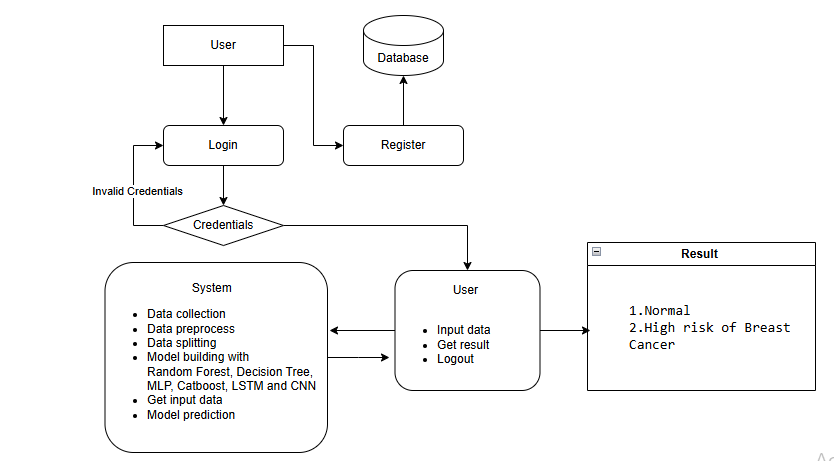
Block Diagram
Specifications
Hardware Requirements
Processor - I3/Intel Processor
Hard Disk - 160GB
Key Board - Standard Windows Keyboard
Mouse - Two or Three Button Mouse
Monitor - SVGA
RAM - 8GB
Software Requirements:
Operating System : Windows 7/8/10
Server side Script : HTML, CSS, Bootstrap & JS
Programming Language : Python
Libraries : Django, Pandas, Os, Numpy, Scikit-learn, XGBoost.
IDE/Workbench : VS Code
Technology : Python 3.10
Database : SQLite


 Paper Publishing

Request Call Back
Would you like to receive a free callback now?
Choose the best time for callback:
Leave your message and we will contact you as soon as possible

6-2-85/B, Old Maternity Hospital Road, Thyagaraja Nagar, Tirupati, Andhra Pradesh – 517501
+91 9030333433
+91 9393939065
0877-2261612

Disclaimer - Takeoff Edu Group Projects are not associated or affiliated with IEEE in any way. The IEEE Projects mentioned here are mentioned in the context of student projects, whose ideas are derived from IEEE publications, not projects of or by IEEE.

