An Ensemble Deep Learning Model for Vehicular Engine Health Prediction
Objective
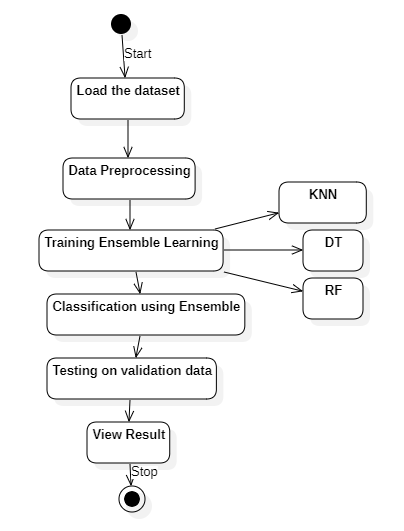
The project aims to develop an ensemble deep learning model using Random Forest and KNN algorithms for predictive maintenance of vehicular engine health. It seeks to leverage Random Forest's robustness with complex data and KNN's local pattern recognition to enhance prediction accuracy and reliability.Specifically, the project involves preprocessing and analyzing sensor data from vehicle engines to extract relevant features indicative of engine health. By training the ensemble model on historical data, the goal is to build a predictive framework capable of early detection of engine degradation and recommending proactive maintenance actions. Ultimately, the project aims to improve vehicle reliability, reduce maintenance costs, and optimize operational efficiency in automotive engineering applications.
Abstract
In the realm of predictive maintenance for vehicular engines, the accurate assessment of health conditions plays a pivotal role in enhancing reliability and reducing operational costs. This project introduces an ensemble deep learning approach aimed at predicting engine health based on diverse machine learning algorithms. The ensemble comprises Decision Trees, Random Forest, K-Nearest Neighbors (KNN), Linear Discriminant Analysis (LDA), Adaboost, and Logistic Regression, each contributing uniquely to the predictive model.
Among these algorithms, Random Forest emerged as the primary predictor, achieving an accuracy of 84% in health condition predictions. This ensemble strategy harnesses the strengths of individual models to mitigate weaknesses and enhance overall predictive performance. By combining the diverse predictions from multiple models, the ensemble leverages their collective wisdom, resulting in robust predictions that are resilient to varying data conditions and outliers.
The methodology involves preprocessing engine sensor data to extract relevant features, followed by training each model on historical data to capture patterns indicative of engine health states. Subsequently, the ensemble framework aggregates individual model outputs to provide a consolidated prediction, yielding superior accuracy compared to standalone algorithms.
This project contributes to advancing predictive maintenance practices in automotive engineering, offering a reliable framework for early detection of potential engine failures and proactive maintenance scheduling. The results underscore the efficacy of ensemble deep learning approaches in complex predictive tasks, demonstrating their applicability and effectiveness in real-world scenarios.
Keywords: Predictive maintenance, Ensemble learning, Vehicular health, Engine diagnostics,
Machine learning algorithms, Predictive modelling, Random Forest.
NOTE: Without the concern of our team, please don't submit to the college. This Abstract varies based on student requirements.
Block Diagram
Specifications
Hardware Requirements:
Operating system : Windows 7 or 7+
RAM : 8 GB
Hard disc or SSD : More than 500 GB
Processor : Intel 3rd generation or high or Ryzen with 8 GB Ram
Software Requirements:
Software’s : Python 3.10 or high version
IDE : Visual Studio Code.
Framework : Flask

Demo Video


Request for Video
 Paper Publishing
Request Call Back
Would you like to receive a free callback now?
Choose the best time for callback:
Leave your message and we will contact you as soon as possible

6-2-85/B, Old Maternity Hospital Road, Thyagaraja Nagar, Tirupati, Andhra Pradesh – 517501
+91 9030333433
+91 9393939065
0877-2261612

Disclaimer - Takeoff Edu Group Projects are not associated or affiliated with IEEE in any way. The IEEE Projects mentioned here are mentioned in the context of student projects, whose ideas are derived from IEEE publications, not projects of or by IEEE.

