An Enhanced Residual Architecture for Automated Detection of Bone Metastasis on WholeBody SPECT Images
Objective
This project presents a Flask-based web application for the rapid and accurate classification of microorganisms using a hybrid model that combines deep learning and machine learning techniques. ResNet is employed for deep feature extraction, followed by classification using a Random Forest algorithm, achieving superior accuracy and robustness compared to standalone models. The application allows users to register, log in, and upload microorganism images through a user-friendly interface. It classifies samples into eight categories, including Amoeba, Euglena, Hydra, and various bacteria types. Designed for laboratory and academic use, the system offers real-time predictions and reliable microorganism identification.
Abstract
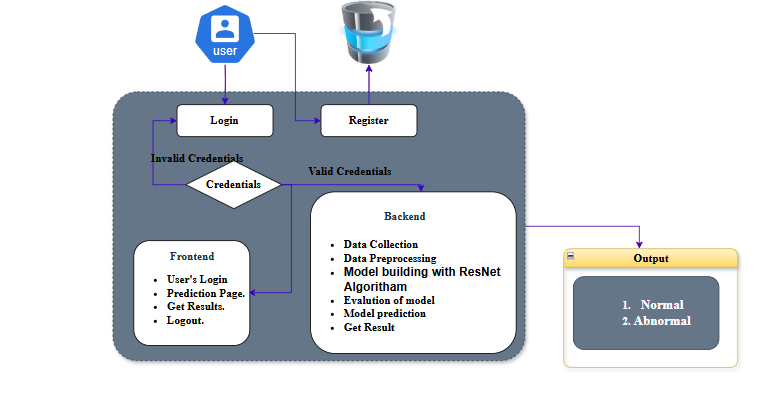
Bone metastases are a critical complication in oncology, demanding prompt and reliable detection to inform therapeutic strategies. This project employs the BS-80K whole-body SPECT dataset from Kaggle to develop an automated binary classifier that distinguishes normal from abnormal scans. We utilize the ResNet50 convolutional architecture, enhanced with residual connections, to improve gradient flow and representation learning for effective feature extraction. A robust preprocessing pipeline performs intensity normalization, image denoising, and data augmentation (random flips, rotations, and scaling) to enhance model generalization across heterogeneous patient data. The model is trained and validated within a Python/Flask backend, which handles image ingestion, inference, and response formatting. The user interface, implemented with HTML, CSS, and vanilla JavaScript, enables clinicians to upload SPECT images and receive classification results in real time. A comprehensive evaluation is conducted to assess predictive performance, inference latency, and computational efficiency, validating the system’s suitability for deployment in diverse clinical environments. By integrating the optimized ResNet50 architecture with a lightweight web service, this work presents a scalable solution to accelerate bone metastasis screening and support decision-making in both high-throughput centers and resource-constrained settings.
Keywords: Bone Metastasis; SPECT Imaging; ResNet50; Residual Connections; Flask; Deep Learning; Web-Based Classification.
NOTE: Without the concern of our team, please don't submit to the college. This Abstract varies based on student requirements.
Block Diagram
Specifications
SOFTWARE REQUIREMENS
Operating System : Windows 7/8/10
Server side Script : HTML, CSS, Bootstrap & JS
Programming Language : Python
Libraries Flask, Pandas, Torch, Sklearn,Numpy , Seaborn
IDE/Workbench : VSCode
Technology : Python 3.6+
Server Deployment : Xampp Server
Database : MySQL
HARDWARE REQUIREMENTS
Processor - I3/Intel Processor
RAM - 8GB (min)
Hard Disk - 128 GB
Key Board - Standard Windows Keyboard
Mouse - Two or Three Button Mouse
Monitor - Any

Demo Video


Request for Video
 Paper Publishing
Request Call Back
Would you like to receive a free callback now?
Choose the best time for callback:
Leave your message and we will contact you as soon as possible

6-2-85/B, Old Maternity Hospital Road, Thyagaraja Nagar, Tirupati, Andhra Pradesh – 517501
+91 9030333433
+91 9393939065
0877-2261612

Disclaimer - Takeoff Edu Group Projects are not associated or affiliated with IEEE in any way. The IEEE Projects mentioned here are mentioned in the context of student projects, whose ideas are derived from IEEE publications, not projects of or by IEEE.

