An Enhanced EPP-MPPT Algorithm With Modified Control Technique in Solar-Based Inverter Applications: Analysis and Experimentation
Objective
The main objective of this project is to optimize the overall output power and add to the reliability, which is paramount for this industry
Abstract
-In this paper, an optimized adaptive perturb-perturb (PP) based algorithm is presented. The modified algorithm has a predictive variable step size calculated through the Newton-Raphson procedure, making its programming effort simple. This combination merits fewer calculations, faster response time and can simply be applied effectively in both bright and shady conditions. The algorithm is developed as a C language code linked to the PSIM simulation representing a typical photovoltaic module system. The proposed algorithm’s simulation results proved faster tracking time response with a reduced error than the standard system.
The tracking time is ten times faster than the MPPT method and reduced by 10 seconds in a 100 kHz converter. The measured error is less than 0.03% at steady state. A modified control modulation scheme is blended with the algorithm as well. Experimental results are provided using a 10 W prototype for telecom applications and another 300W practical micro inverter as a proof of concept, and in agreement with both modelling and simulation results.
In addition, the results validate the viability of the proposed algorithm in the cases of linear (resistor) and non-linear (brushless motor) loads. The PSIM and experimental setups are provided to prove the concept of the proposed methodology, which is critical for universal solar-inverter applications.
Keywords: DC-DC converters, MPPT improved algorithms, rural water pump applications, solar energy, standalone rural inverters, telecom distribution.
NOTE: Without the concern of our team, please don't submit to the college. This Abstract varies based on student requirements.
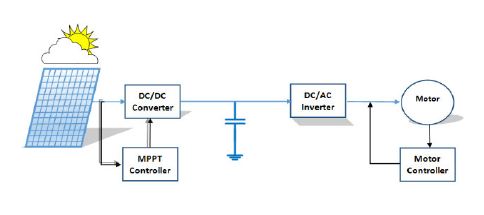
Block Diagram
Specifications
Software Configuration:
Operating System : Windows 7/8/10
Application Software : Matlab/Simulink
Hardware Configuration:
RAM : 8 GB
Processor : I3 / I5(Mostly prefer)
Learning Outcomes
- Introduction to Matlab/Simulink
- What is EISPACK & LINPACK
- How to start with MATLAB
- About Matlab language
- About tools & libraries
- Application of Matlab/Simulink
- About Matlab desktop
- Features of Matlab/Simulink
- Basics on Matlab/Simulink
- Introduction to controllers.
- Study of PWM techniques.
- Project Development Skills:
- Problem analyzing skills
- Problem solving skills
- Creativity and imaginary skills
- Programming skills
- Deployment
- Testing skills
- Debugging skills
- Project presentation skills
- Thesis writing skills


 Paper Publishing

Request Call Back
Would you like to receive a free callback now?
Choose the best time for callback:
Leave your message and we will contact you as soon as possible

6-2-85/B, Old Maternity Hospital Road, Thyagaraja Nagar, Tirupati, Andhra Pradesh – 517501
+91 9030333433
+91 9393939065
0877-2261612

Disclaimer - Takeoff Edu Group Projects are not associated or affiliated with IEEE in any way. The IEEE Projects mentioned here are mentioned in the context of student projects, whose ideas are derived from IEEE publications, not projects of or by IEEE.

