An Efficient Parallel DA-Based Fixed-Width Design for Approximate Inner-Product Computation
Also Available Domains DSP Core|Xilinx Vivado
Objective
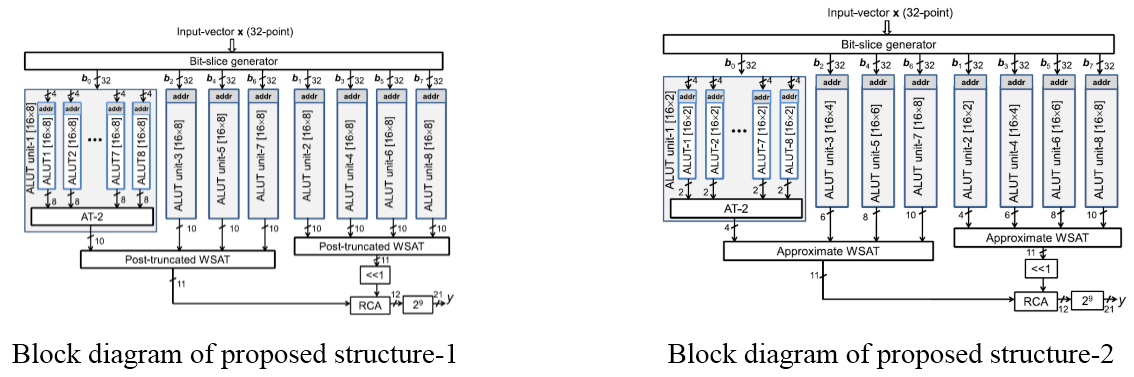
The aim of this project is to implement with three variants of approximate PDA-based structures based on an efficient truncation model. To achieve higher bit saving with relatively less truncation error, a novel approach was designed with approximate LUTs, ATs, and WSAT with truncated operands
Abstract
Parallel Distributed Arithmetic forms are core of many important Digital Signal Processing (DSP) functions such as linear and circular convolutions, correlation, digital filtering, and discrete trigonometric transforms. In this project, a novel PDA-based structures is proposed based on efficient truncation model.
A hardware-efficient fixed-width PDA-based inner-product structures was obtained by using approximate Look-Up Tables (LUTs), Adder Trees (ATs), and Wallace-like Shift-AT (SAT) with truncated operands. In this project, three different inner product architectures is implemented based on their variants like area, delay etc. The effectiveness of the proposed method is designed using Xilinx ISE 14.7
Keywords: Approximate computation, Distributed Arithmetic (DA), Look Up Table, Adders.
NOTE: Without the concern of our team, please don't submit to the college. This Abstract varies based on student requirements.
Block Diagram
Specifications
Software Requirements:
- Xilinx ISE 14.7
- HDL: Verilog
Hardware Requirements:
- Microsoft® Windows XP
- Intel® Pentium® 4 processor or Pentium 4 equivalent with SSE support
- 512 MB RAM
- 100 MB of available disk space
Learning Outcomes
- Basics of Digital Electronics
- FPGA design Flow
- Introduction to Verilog Coding.
- Different modeling styles in Verilog
- Data Flow modeling
- Structural modeling
- Behavioral modeling
- Mixed level modeling
- Introduction to Distributed Arithmetic Circuits
- Concept of Approximation
- Importance of Approximate computing
- Drawbacks of Exact Computing in error tolerant applications
- Applying approximate computing various error tolerant applications
- How to achieve high speed , Low power and Area efficiency?
- Scope of approximation concept in today’s world
- Applications in real time
- Xilinx ISE 14.7 for design and simulation
- Generation of Netlist
- Solution providing for real time problems
- Project Development Skills:
- Problem Analysis Skills
- Problem Solving Skills
- Logical Skills
- Designing Skills
- Testing Skills
- Debugging Skills
- Presentation Skills
- Thesis Writing Skills


 Paper Publishing

Request Call Back
Would you like to receive a free callback now?
Choose the best time for callback:
Leave your message and we will contact you as soon as possible

6-2-85/B, Old Maternity Hospital Road, Thyagaraja Nagar, Tirupati, Andhra Pradesh – 517501
+91 9030333433
+91 9393939065
0877-2261612

Disclaimer - Takeoff Edu Group Projects are not associated or affiliated with IEEE in any way. The IEEE Projects mentioned here are mentioned in the context of student projects, whose ideas are derived from IEEE publications, not projects of or by IEEE.

