An Efficient Malware Detection Approach Based on Machine Learning Feature Influence Techniques for Resource-Constrained Devices
Objective
The goal is to develop a lightweight malware detection system optimized for resource-constrained environments by implementing and comparing various machine learning algorithms, while using feature selection techniques to enhance accuracy and reduce complexity. Additionally, a simple frontend will be designed for local interaction, and the system's performance will be validated using key metrics like accuracy, precision, recall, and execution time to ensure suitability for low-power devices.
Abstract
The proliferation of malicious software poses a persistent threat to digital security, particularly in environments with constrained computational resources. Traditional malware detection systems often rely on resource-intensive operations, making them unsuitable for low-power devices. This research proposes an efficient machine learning-based approach for malware classification that emphasizes feature influence techniques to optimize performance for such devices. The study focuses on distinguishing between malware and legitimate software using a binary classification model. A comparative evaluation of existing algorithms Random Forest and Extra Trees classifiers is conducted against the proposed Decision Tree and XGBoost models. The goal is to assess model performance in terms of accuracy, precision, recall, and computational efficiency while reducing model complexity without compromising detection capabilities. Feature importance analysis is employed to select the most impactful attributes, thereby streamlining the learning process and minimizing resource usage. The experimental results demonstrate that the proposed models, particularly XGBoost, achieve competitive accuracy with significantly reduced computational overhead compared to ensemble-based methods. This confirms the effectiveness of employing lightweight classifiers alongside feature influence techniques in improving malware detection performance on resource-limited platforms. The findings suggest that intelligent model selection and targeted feature reduction are key strategies in developing practical and deployable malware detection systems suitable for devices with limited processing power.
Keywords: Malware detection, Machine learning, XGBoost, Decision tree, Feature selection, Binary classification, Lightweight models, Resource-constrained devices, Feature importance, Cybersecurity.
NOTE: Without the concern of our team, please don't submit to the college. This Abstract varies based on student requirements.
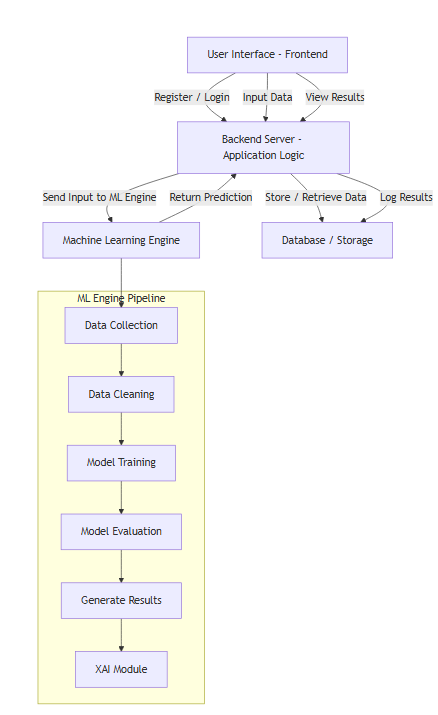
Block Diagram
Specifications
Hardware Requirements
Processor - I3/Intel Processor
Hard Disk - 160GB
Key Board - Standard Windows Keyboard
Mouse - Two or Three Button Mouse
Monitor - SVGA
RAM - 8GB
Software Requirements:
Operating System : Windows 7/8/10
Server side Script : HTML, CSS, Bootstrap & JS
Programming Language : Python
Libraries : Flask/Django, Pandas, Mysql.connector, Os, Smtplib, Numpy
IDE/Workbench : PyCharm
Technology : Python 3.6+
Server Deployment : Xampp Server
Database : MySQL

Demo Video


Request for Video
 Paper Publishing
Request Call Back
Would you like to receive a free callback now?
Choose the best time for callback:
Leave your message and we will contact you as soon as possible

6-2-85/B, Old Maternity Hospital Road, Thyagaraja Nagar, Tirupati, Andhra Pradesh – 517501
+91 9030333433
+91 9393939065
0877-2261612

Disclaimer - Takeoff Edu Group Projects are not associated or affiliated with IEEE in any way. The IEEE Projects mentioned here are mentioned in the context of student projects, whose ideas are derived from IEEE publications, not projects of or by IEEE.

