An Area-Efficient High-Resolution Segmented ?-?-DAC for Built-In Self-Test Applications
Objective
In this article, a segmented DAC architecture is proposed. The proposed architecture is realized using two sub-DACs, where both are delta sigma-based.
Abstract
This article proposes a segmented architecture for Sigma-delta (ΣΔ) digital-to-analog converters (DACs) to be utilized in built-in self-test (BIST) schemes for programmable DC voltage generators. ΣΔ-DACs are known for their high linearity; however, they come with drawbacks, such as significant digital memory requirements and the need for a large reconstruction filter with a substantial silicon area footprint. The proposed segmented DAC architecture overcomes these challenges by employing two sub-DACs, both based on ΣΔ technology. This approach offers two key advantages: a reduction in the footprint size of the reconstruction filter and substantial memory savings, leading to a simpler BIST solution. Two experimental prototypes demonstrate the benefits of the segmented ΣΔ-DAC. The first prototype is an integrated circuit (IC) design implemented using TSMC 65-nm CMOS technology. It achieves 12 bits of resolution using only 1020 memory elements, while an unsegmented ΣΔ-DAC requires 4095 elements to achieve the same resolution. This results in memory element savings. Furthermore, the segmented prototype occupies only 0.5 mm² of silicon area, whereas the unsegmented design occupies 0.77 mm² for the same resolution, presenting a silicon area reduction compared to its unsegmented counterpart. The second prototype involves implementing the segmented ΣΔ-DAC architecture using discrete components. Remarkably, this discrete prototype achieves 16 bits of resolution using just 1020 memory elements, whereas the unsegmented counterpart necessitates 65,535 bits for the same resolution. This leads to an impressive reduction in memory elements.
Keywords: Built-in self-test (BIST), low-pass filter (LPF), short-term average, sigma–delta (
) digital-to-analog converters (DACs).NOTE: Without the concern of our team, please don't submit to the college. This Abstract varies based on student requirements.
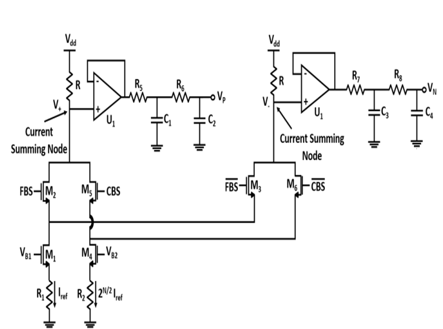
Block Diagram
Specifications
Software Requirements:
· Cadence virtuoso
· Technology files: gpdk180
Hardware Requirements:
· Microsoft® Windows XP
· Intel® Pentium® 4 processor or Pentium 4 equivalent with SSE support
· 512 MB RAM
· 100 MB of available disk space
Learning Outcomes
- Introduction to Digital electronics
- Importance of Transistors
- MOS Fundamentals
- NMOS/PMOS/CMOS Technologies
- How to design circuits using Transistor logic?
- Scope of multipliers in today’s world
- Applications in Real time.
- DAC importance.
- Cadence for design and simulation
- Solution providing for real time problems
- Project Development Skills:
- Problem Analysis Skills
- Problem Solving Skills
- Logical Skills
- Designing Skills
- Testing Skills
- Debugging Skills
- Presentation skills
- Thesis Writing Skills


 Paper Publishing

Request Call Back
Would you like to receive a free callback now?
Choose the best time for callback:
Leave your message and we will contact you as soon as possible

6-2-85/B, Old Maternity Hospital Road, Thyagaraja Nagar, Tirupati, Andhra Pradesh – 517501
+91 9030333433
+91 9393939065
0877-2261612

Disclaimer - Takeoff Edu Group Projects are not associated or affiliated with IEEE in any way. The IEEE Projects mentioned here are mentioned in the context of student projects, whose ideas are derived from IEEE publications, not projects of or by IEEE.

