An Adaptive Intrusion Detection System for Evolving IoT Threats An Autoencoder FNN Fusion
Objective
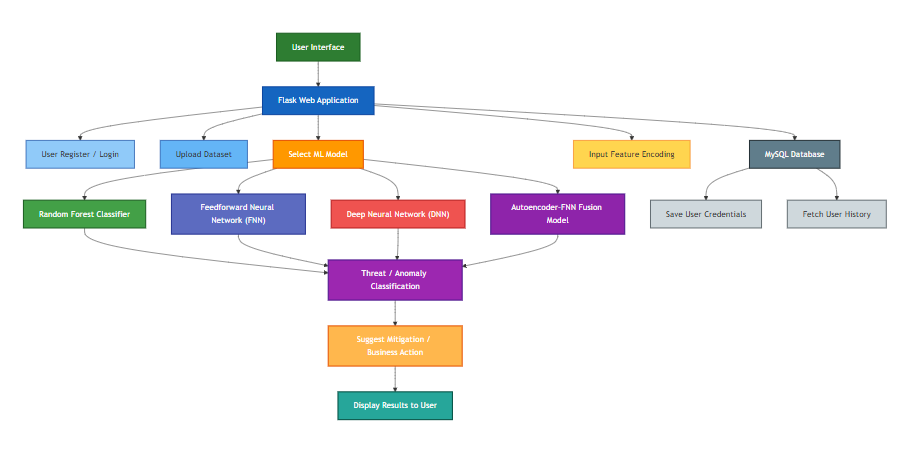
An Adaptive Intrusion Detection System for Evolving IoT Threats Using Autoencoder–FNN Fusion focuses on building a smart and dynamic security framework capable of detecting complex and emerging cyberattacks in IoT networks. The system combines an Autoencoder for efficient feature extraction with a Feedforward Neural Network (FNN) for accurate classification. This fusion enables the model to learn normal behavior patterns and quickly identify anomalies or intrusion attempts. The adaptive nature of the approach ensures continuous learning as new threats evolve, making it suitable for large-scale IoT environments requiring real-time, robust, and intelligent cyber-defense mechanisms.
Abstract
The rapid expansion of the Internet of Things (IoT) has introduced a vast attack surface, resulting in diverse and evolving cyber threats that challenge conventional Intrusion Detection Systems (IDS). This project, titled “An Adaptive Intrusion Detection System for Evolving IoT Threats using Autoencoder–FNN Fusion,” presents a hybrid deep learning approach that enhances detection accuracy and adaptability against dynamic IoT attacks. The proposed framework integrates an Autoencoder (AE) for feature compression and noise reduction with a Feedforward Neural Network (FNN) classifier for intelligent threat categorization. The Auto encoder learns deep latent representations of IoT traffic data, capturing intrinsic patterns that help detect both known and zero-day attacks, while the FNN refines classification with improved generalization. A Random Forest model is also employed as a baseline to validate performance consistency and robustness. The system achieves adaptive learning by periodically retraining with new traffic data, ensuring resilience to evolving threat behaviors. Extensive experimentation demonstrates that the AE–FNN model achieves high detection accuracy and reduced false alarm rates compared to traditional machine learning models. The developed web interface allows users to upload IoT datasets, visualize predictions, and analyze detected attack types effectively. Overall, this adaptive AE–FNN Fusion IDS offers a scalable, intelligent, and future-ready solution for safeguarding IoT environments against emerging network intrusions.
Keywords: Intrusion Detection System, IoT Security, Autoencoder, Feedforward Neural Network, Deep Learning, Random Forest, Adaptive Learning, Cyber Threat Detection.
NOTE: Without the concern of our team, please don't submit to the college. This Abstract varies based on student requirements.
Block Diagram
Specifications
4.1 SOFTWARE REQUIREMENS
Operating System : Windows 7/8/10
Server side Script : HTML, CSS, Bootstrap & JS
Programming Language : Python
Libraries : Flask, Pandas, Torch, Keras, Sklearn, Numpy , Seaborn
IDE/Workbench : VSCODE
Server Deployment : Xampp Server
Database : MySQL
4.2 HARDWARE REQUIREMENTS
Processor - I3/Intel Processor
RAM - 8GB (min)
Hard Disk - 128 GB
Key Board - Standard Windows Keyboard
Mouse - Two or Three Button Mouse
Monitor - Any


 Paper Publishing

Request Call Back
Would you like to receive a free callback now?
Choose the best time for callback:
Leave your message and we will contact you as soon as possible

6-2-85/B, Old Maternity Hospital Road, Thyagaraja Nagar, Tirupati, Andhra Pradesh – 517501
+91 9030333433
+91 9393939065
0877-2261612

Disclaimer - Takeoff Edu Group Projects are not associated or affiliated with IEEE in any way. The IEEE Projects mentioned here are mentioned in the context of student projects, whose ideas are derived from IEEE publications, not projects of or by IEEE.

