An Adaptive Fast-Response Sensor Integrated Smart Helmet for Blind-Spot Protection and Guidance to Avoid Unavoidable Occurrences
Also Available Domains Arduino
Objective
Motorcycles are increasing in numbers as more online travel services are becoming available, and it is easier and cost efficient for both the rider and driver to travel places in Bangladesh. As the number of motorcycles increases, so are the chances of accidents related to them. The idea behind developing this proposed model roots from the social responsibility we have towards society. The primary causes of death due to accidents are the lack thereof emergency medical services and information relating to the accident such time, place, and other factors. The aim of this proposed model design is to provide necessary services in the event of a motorcycle accident so that necessary actions can be taken to save the life of the injured and give blind-spot protection to the rider. This system is based on Arduino and consists of microcontrollers, GSM, GPS, and sensors for the detection of the accident and to examine the condition of the rider.
Abstract
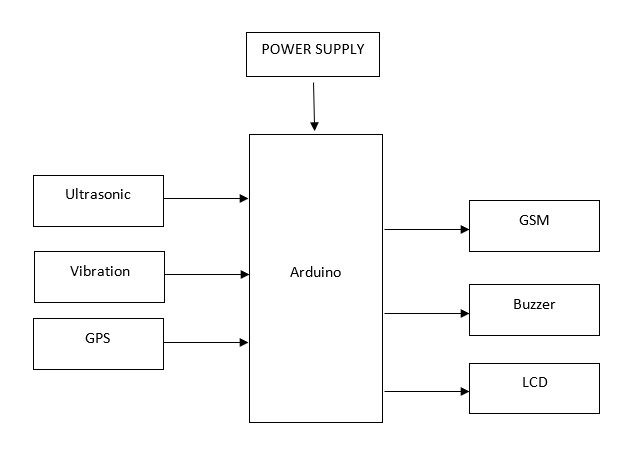
Road accidents caused by blind-spot collisions and delayed emergency response have become major safety concerns for riders and drivers. This project presents an Adaptive Fast-Response Sensor Integrated Smart Helmet for Blind-Spot Protection and Guidance to Avoid Unavoidable Occurrences using sensor-based monitoring and emergency alert technologies. The proposed system uses an Arduino microcontroller integrated with ultrasonic and vibration sensors to improve rider safety and accident monitoring.The ultrasonic sensor is used to detect nearby obstacles and blind-spot conditions by measuring distance continuously, helping riders avoid collisions and unsafe movements. A vibration sensor is used to detect sudden impacts or accident conditions. An LCD display is used to show monitoring status and system information, while a buzzer provides immediate alert notifications during dangerous situations.If an accident or abnormal condition is detected, the system automatically activates GSM and GPS modules to send emergency alert messages along with the rider’s location details for quick assistance and safety support.The proposed system improves rider protection, supports blind-spot monitoring, enhances accident detection accuracy, and provides emergency location-based alert services using embedded system and communication technologies.
NOTE: Without the concern of our team, please don't submit to the college. This Abstract varies based on student requirements.
Block Diagram
Specifications
Hardware components:
- Arduino Uno
- Ultrasonic Sensor
- Vibration Sensor
- GSM Module
- GPS Module
- LCD Display
- Buzzer
- Smart Helmet
- Power Supply
- 12V Adapter
- Connectors – 30
Software components:
- Embedded C
- Arduino IDE
Learning Outcomes
- Arduino pin diagram and architecture
- How to install Arduino IDE and required software
- Setting up and installation procedure for Arduino IDE
- Introduction to Arduino development environment
- Basics of Embedded C / Python programming
- Basics of IoT platforms
- Working of power supply
- About Project Development Life Cycle:
- Planning and Requirement Gathering (software’s, tools, hardware components, etc.,)
- Schematic preparation
- Code development and debugging
- Hardware development and debugging
- Development of the Project and Output testing
- Practical exposure to:
- Hardware and software tools
- Solution providing for real-time problems
- Working with team / individual
- Work on creative ideas
- Project development Skills:
- Problem analyzing skills
- Problem solving skills
- Creativity and imaginary skills
- Programming skills
- Deployment
- Testing skills
- Debugging skills
- Project presentation skills
- Thesis writing skills


 Paper Publishing

Request Call Back
Would you like to receive a free callback now?
Choose the best time for callback:
Leave your message and we will contact you as soon as possible

6-2-85/B, Old Maternity Hospital Road, Thyagaraja Nagar, Tirupati, Andhra Pradesh – 517501
+91 9030333433
+91 9393939065
0877-2261612

Disclaimer - Takeoff Edu Group Projects are not associated or affiliated with IEEE in any way. The IEEE Projects mentioned here are mentioned in the context of student projects, whose ideas are derived from IEEE publications, not projects of or by IEEE.

