AIPowered MultiInput Deep Learning System for NonInvasive Early Detection of Vitamin Deficiencies
Objective
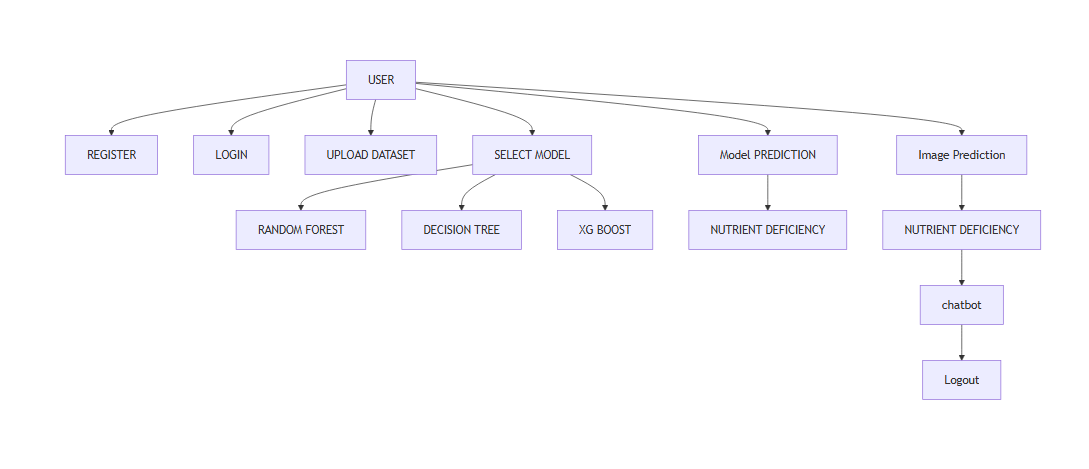
The main objective of this project is to create a machine learning-based system that predicts nutrient deficiencies, specifically Iron, Vitamin C, Vitamin B12, and Vitamin D, by analyzing symptoms. The system integrates various machine learning algorithms, including Decision Tree, Random Forest, XGBoost, and CNN, to accurately predict deficiencies. By incorporating a chatbot, the project also aims to provide users with an interactive and personalized experience. The chatbot will explain the predicted deficiencies, suggest corrective dietary changes, and offer guidance on improving nutrition. This system is designed to be user-friendly, accessible via a Flask-based web application, and capable of providing early detection of nutritional health issues, enabling users to make informed decisions regarding their diet and health.
Abstract
This project develops a machine learning system for predicting nutrient deficiencies, including Iron, Vitamin C, Vitamin B12, and Vitamin D, by analyzing symptoms observed in individuals. The system employs algorithms such as Decision Tree, Random Forest, XGBoost, and Convolutional Neural Networks (CNN) to enhance prediction accuracy. The CNN model analyzes visual data, such as images or scans of nutritional deficiencies, alongside symptom data for a more comprehensive analysis. Additionally, a chatbot interface is integrated into the web application, providing personalized interactions to users. The chatbot helps users understand their nutritional health, explains the predictions, and suggests dietary changes based on the deficiency identified. Built with Flask for easy access, this web application aims to increase health awareness and enable individuals to make informed decisions regarding their nutrition. By combining advanced machine learning techniques with user-friendly interactions, the system ensures accuracy and provides an intuitive experience for early detection of nutritional health issues.
Keywords: Nutrient Deficiency Prediction, Machine Learning, Decision Tree, Random Forest, XGBoost, CNN, chatbot , Symptom-Based Diagnosis, Flask, Healthcare Technology, Nutritional Health Monitoring.
NOTE: Without the concern of our team, please don't submit to the college. This Abstract varies based on student requirements.
Block Diagram
Specifications
4.1 Software Requirements:
Ø OS: Windows, Linux, or macOS
Ø Language & Framework: Python 3.x with Django
Ø Libraries: scikit-learn, pandas, NumPy, matplotlib, seaborn, nltk
Ø Front-end: HTML, CSS, JavaScript
Ø Database: SQLite or MySQL/PostgreSQL
Ø IDE: VS Code, PyCharm, or any Python IDE
4.2 Hardware Requirements:
Ø Processor: Intel i3 / AMD equivalent or higher
Ø RAM: 8 GB minimum (16 GB recommended)
Ø Storage: 256 GB HDD/SSD
Ø Internet: Required for libraries, datasets, and deployment


 Paper Publishing

Request Call Back
Would you like to receive a free callback now?
Choose the best time for callback:
Leave your message and we will contact you as soon as possible

6-2-85/B, Old Maternity Hospital Road, Thyagaraja Nagar, Tirupati, Andhra Pradesh – 517501
+91 9030333433
+91 9393939065
0877-2261612

Disclaimer - Takeoff Edu Group Projects are not associated or affiliated with IEEE in any way. The IEEE Projects mentioned here are mentioned in the context of student projects, whose ideas are derived from IEEE publications, not projects of or by IEEE.

