AI traffic light mangement system
Objective
The main objective of the AI Traffic Light Management System is to develop an intelligent traffic control system that can automatically manage traffic signals based on real-time vehicle detection. The system uses a camera and Python-based image processing to identify the presence of vehicles and control traffic lights efficiently through an Arduino microcontroller.
Abstract
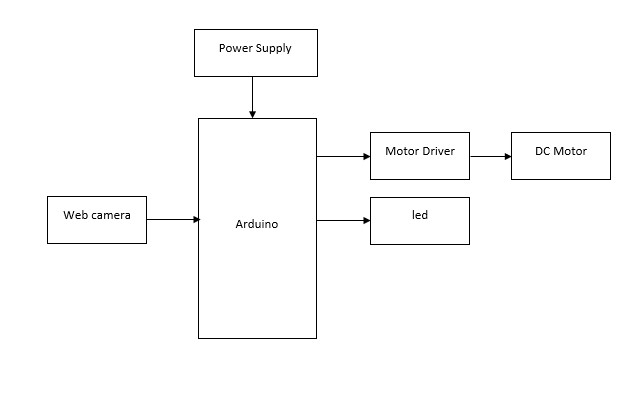
This project presents a traffic management system that integrates computer vision and embedded control to enhance road monitoring and vehicle regulation at a four-way junction. A USB camera captures traffic flow from each direction, and the visual data is processed through a YOLOv8-based image processing framework to identify and count vehicles. The Arduino UNO serves as the central controller, interfacing with LEDs that act as traffic signals and a DC motor mechanism that rotates the camera to sequentially observe all road segments. The motor is operated through an L293D motor driver module, enabling directional control for comprehensive coverage. Based on the processed data, the system prioritizes the road segment with the highest vehicle density by assigning a green signal, while other roads remain halted through red or yellow signals. The design employs a 5V regulated power supply supported by a 12V adapter to operate sensors, indicators, and control units. This integration of computer vision with microcontroller-based actuation demonstrates a structured approach to traffic regulation, reducing congestion and improving traffic flow management at intersections.
NOTE: Without the concern of our team, please don't submit to the college. This Abstract varies based on student requirements.
Block Diagram
Specifications
Hardware components:
- Arduino uno
- leds
- Motor driver
- Power supply
- USB WEB camera
- DC Motor
Software components:
- Python
- Arduino ide
- Embedded c
Learning Outcomes
- Arduino pin diagram and architecture
- How to install Arduino IDE and required software
- Setting up and installation procedure for Arduino IDE
- Introduction to Arduino development environment
- Basics of Embedded C / Python programming
- Basics of IoT platforms
- Working of power supply
- About Project Development Life Cycle:
- Planning and Requirement Gathering (software’s, tools, hardware components, etc.,)
- Schematic preparation
- Code development and debugging
- Hardware development and debugging
- Development of the Project and Output testing
- Practical exposure to:
- Hardware and software tools
- Solution providing for real-time problems
- Working with team / individual
- Work on creative ideas
- Project development Skills:
- Problem analyzing skills
- Problem solving skills
- Creativity and imaginary skills
- Programming skills
- Deployment
- Testing skills
- Debugging skills
- Project presentation skills
- Thesis writing skills


 Paper Publishing

Request Call Back
Would you like to receive a free callback now?
Choose the best time for callback:
Leave your message and we will contact you as soon as possible

6-2-85/B, Old Maternity Hospital Road, Thyagaraja Nagar, Tirupati, Andhra Pradesh – 517501
+91 9030333433
+91 9393939065
0877-2261612

Disclaimer - Takeoff Edu Group Projects are not associated or affiliated with IEEE in any way. The IEEE Projects mentioned here are mentioned in the context of student projects, whose ideas are derived from IEEE publications, not projects of or by IEEE.

