AI Powered Travel Planner
Objective
The main objective of the Department Digital Hub is to streamline departmental communication and academic operations efficiently. It aims to reduce information loss by centralizing student, faculty, and HOD interactions in a single platform. The system seeks to automate routine tasks such as attendance tracking, leave management, announcements, and polls. It provides a smart repository for projects to encourage reuse, prevent duplication, and facilitate easy access to past work. AI integration enables doubt resolution, note summarization, and intelligent technical search for improved learning support. The platform aims to generate insights through analytics on domain trends and technical contributions. It focuses on enhancing collaboration, knowledge sharing, and transparency across all academic and technical activities. Overall, it aspires to create a sustainable ecosystem for academic and technical intelligence within the department.
Abstract
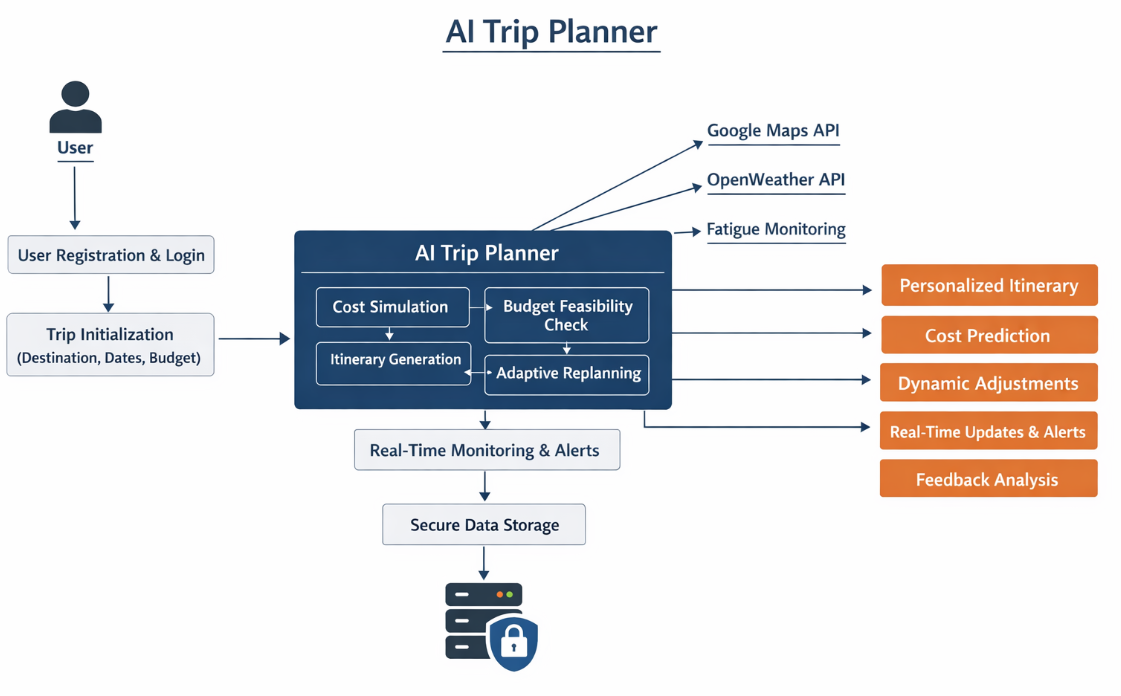
In this paper, we present the design and development of an AI-powered "AI Trip Planner" application aimed at enhancing the travel planning experience for users in India. The system integrates machine learning models to provide personalized travel recommendations based on user preferences, trip budget, and health-related factors. By utilizing multiple APIs, such as Google Maps Platform and Open-Weather API, the application offers dynamic features like cost simulation, trip prediction, weather updates, and real-time itinerary adjustments. The system is structured around a user-centric design, including features like registration, login, trip initialization, cost prediction, budget feasibility assessment, adaptive re-planning, and real-time monitoring. Key functionalities include trip planning, feedback storage, and continuous system improvements based on user data. The integration of machine learning algorithms and third-party APIs ensures personalized and accurate trip recommendations, with the goal of optimizing travel experiences. The system also enhances future trip planning by learning from user feedback, providing a scalable solution for users seeking to plan trips effectively and efficiently. The paper discusses the architecture, methodology, and key components, offering a comprehensive solution for smarter travel planning.
Keywords—AI Trip Planner, Machine Learning, Personalized Travel Recommendations, Budget Feasibility, Cost Prediction, Adaptive Re-planner, Google Maps API, Open-Weather API, Dynamic Itinerary, Real-Time Monitoring, User Feedback, Travel Planning.
NOTE: Without the concern of our team, please don't submit to the college. This Abstract varies based on student requirements.
Block Diagram
Specifications
SOFTWARE REQUIREMENTS:
ü Operating System: Windows 10/11, macOS, or Linux (Ubuntu 20.04+)
ü Front-End: React.js + JavaScript/TypeScript
ü Back-End: Node.js (v18+) + Express.js
ü Database: MongoDB
HARDWARE REQUIREMENTS:
ü Processor: Intel i5 / Ryzen 5 or better
ü RAM: 16 GB (min 8 GB)
ü Storage: 256 GB SSD (512 GB+ recommended)
ü GPU (recommended) : NVIDIA with CUDA (e.g., GTX 1650 / RTX 3060) for model training
ü Monitor: 15"+ Full HD
ü Internet: Stable 10 Mbps+ (for federated learning, video calls, uploads)


 Paper Publishing

Request Call Back
Would you like to receive a free callback now?
Choose the best time for callback:
Leave your message and we will contact you as soon as possible

6-2-85/B, Old Maternity Hospital Road, Thyagaraja Nagar, Tirupati, Andhra Pradesh – 517501
+91 9030333433
+91 9393939065
0877-2261612

Disclaimer - Takeoff Edu Group Projects are not associated or affiliated with IEEE in any way. The IEEE Projects mentioned here are mentioned in the context of student projects, whose ideas are derived from IEEE publications, not projects of or by IEEE.

