AI-Driven Object Sorting and Storage System Using Raspberry Pi
Objective
To design and implement an AI-based system with Raspberry Pi for autonomously sorting and storing objects into designated locations based on their type using computer vision and motor control.
Abstract
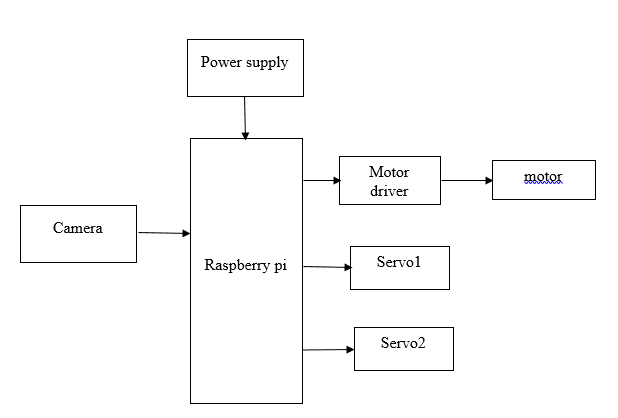
This paper presents an AI-powered object-storing robot utilizing a Raspberry Pi interfaced with a web camera, two servo motors, a DC motor, and a motor driver. The primary objective is to autonomously store objects in designated locations based on their type. The system operates by moving the objects using a motor-driven accelerator, while the web camera continuously monitors and identifies the objects using computer vision techniques. When an object, such as an apple, is detected, the corresponding servo motor is activated to move the object to its predetermined storage area, such as an apple tray. Similarly, other objects like cups and bottles are identified and placed in their respective designated locations. The integration of AI for object detection and the precise control of motors for object manipulation allows for efficient and sorting and storing of various items. This automated approach not only enhances the organization but also reduces the manual effort required for sorting and storing objects. The system's design and implementation are discussed, highlighting its potential applications in smart storage solutions and automated inventory management.
NOTE: Without the concern of our team, please don't submit to the college. This Abstract varies based on student requirements.
Block Diagram
Specifications
Hardware requirements:
- Raspberry pi
- Camera
- Motor driver
- Dc motor
- Servo
- Power supply
Software requirements:
- Raspbian
- Python idle
Learning Outcomes
- Raspberry pi Pin diagram and Architecture
- How to install and setting up of Python IDE
- Basic python coding
- camera interface with Raspberry pi
- camera interface with Raspberry pi
- motor driver interface with Raspberry pi
- servo interface with Raspberry pi
- About Project Development Life Cycle:
- Planning and Requirement Gathering( software’s, Tools, Hardware components, etc.,)
- Schematic preparation
- Code development and debugging
- Hardware development and debugging
- Development of the Project and Output testing
- Practical exposure to:
- Hardware and software tools. ,
- Solution providing for real time problems,
- Working with team/ individual,
- Work on Creative ideas.
- Project development Skills
- Problem analyzing skills
- Problem solving skills
- Creativity and imaginary skills
- Programming skills
- Deployment
- Testing skills
- Debugging skills
- Project presentation skills
- Thesis writing skills


 Paper Publishing

Request Call Back
Would you like to receive a free callback now?
Choose the best time for callback:
Leave your message and we will contact you as soon as possible

6-2-85/B, Old Maternity Hospital Road, Thyagaraja Nagar, Tirupati, Andhra Pradesh – 517501
+91 9030333433
+91 9393939065
0877-2261612

Disclaimer - Takeoff Edu Group Projects are not associated or affiliated with IEEE in any way. The IEEE Projects mentioned here are mentioned in the context of student projects, whose ideas are derived from IEEE publications, not projects of or by IEEE.

