AI-driven intrusion detection system for cloud security
Objective
To develop a hybrid AI-based intrusion detection system that combines machine learning, deep learning, and ensemble techniques for accurate, real-time detection of advanced and zero-day cyber threats in cloud environments.
Abstract
This Intrusion Detection Systems (IDS) are essential for safeguarding modern cloud infrastructures, yet traditional signature-based methods struggle to detect evolving and zero-day cyber threats. Building upon the AI-driven intrusion detection concepts outlined in the base paper
, this work presents an enhanced, multi-layered IDS framework integrating both Machine Learning and Deep Learning techniques for robust threat identification. The proposed system employs Random Forest (100-tree) and Support Vector Machine with RBF kernel for high-precision classification, while LSTM networks capture sequential attack patterns and autoencoders perform anomaly detection on complex traffic distributions. A hybrid weighted-voting ensemble further improves detection reliability by combining heterogeneous model outputs. The system is implemented for real-time intrusion monitoring, providing continuous analysis of streaming network traffic and instant alert generation through a live visualization dashboard. Experimental results demonstrate significant improvements in accuracy, adaptability, and false-positive reduction compared to standalone models and traditional IDS approaches. This integrated AI-based IDS architecture offers a scalable and intelligent solution for securing cloud environments against advanced cyber threats.
Keywords:Artificial Intelligence, Intrusion Detection System (IDS), Cloud Security, Machine Learning, Random Forest, Support Vector Machine (SVM-RBF), Deep Learning, LSTM Network, Autoencoder, Anomaly Detection, Hybrid Ensemble, Real-Time Monitoring, Cybersecurity, Network Traffic Analysis
NOTE: Without the concern of our team, please don't submit to the college. This Abstract varies based on student requirements.
Block Diagram
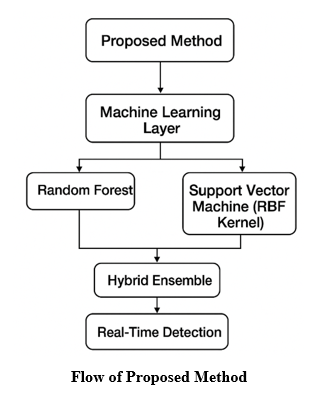
Specifications
Software: Matlab 2022b or above
Hardware:
Operating Systems:
- Windows 10
- Windows 7 Service Pack 1
- Windows Server 2019
- Windows Server 2016
Processors:
Minimum: Any Intel or AMD x86-64 processor
Recommended: Any Intel or AMD x86-64 processor with four logical cores and AVX2 instruction set support
Disk:
Minimum: 2.9 GB of HDD space for MATLAB only, 5-8 GB for a typical installation
Recommended: An SSD is recommended A full installation of all MathWorks products may take up to 29 GB of disk space
RAM:
Minimum: 4 GB
Recommended: 8 GB
Learning Outcomes
· Introduction to Matlab
· What is EISPACK & LINPACK
· How to start with MATLAB
· About Matlab language
· Matlab coding skills
· About tools & libraries
· Application Program Interface in Matlab
· About Matlab desktop
· How to use Matlab editor to create M-Files
· Features of Matlab
· Basics on Matlab
· What is Communication?
· About Communication
· Introduction to Communication
· How Communication Works?
· Importing the System Design, Characterization and Visualization
· Analyzing of BER tool
· Analyzing of Error Rate Test Console
· Generation of WSN
· WSN network creation
· Nodes Communication
· Clustering
· Routing
· Convolutional
· Equalization and Synchronization etc.,
· How to extend our work to another real time applications
· Project development Skills
o Problem analyzing skills
o Problem solving skills
o Creativity and imaginary skills
o Programming skills
o Deployment
o Testing skills
o Debugging skills
o Project presentation skills
o Thesis writing skills
Demo Video


Request for Video
 Paper Publishing
Request Call Back
Would you like to receive a free callback now?
Choose the best time for callback:
Leave your message and we will contact you as soon as possible

6-2-85/B, Old Maternity Hospital Road, Thyagaraja Nagar, Tirupati, Andhra Pradesh – 517501
+91 9030333433
+91 9393939065
0877-2261612

Disclaimer - Takeoff Edu Group Projects are not associated or affiliated with IEEE in any way. The IEEE Projects mentioned here are mentioned in the context of student projects, whose ideas are derived from IEEE publications, not projects of or by IEEE.

