AI Driven Diagnosis Of Oral Malignancies Through Machine Learning and Deep Learning
Objective
Develop an AI system using MobileNet, CNN, and DenseNet to classify oral lesions, enhancing early detection and equitable healthcare access.
Abstract
Oral cancer presents a significant global health challenge, where early detection is critical for improving treatment outcomes. Differentiating between benign and malignant oral lesions typically requires expert analysis, often relying on specialized medical resources that are not universally accessible. This project aims to address this gap by developing an AI-driven diagnostic system designed to enhance the early detection and classification of oral lesions. Leveraging advanced image-based deep learning models, including MobileNet, Convolutional Neural Networks (CNN), and DenseNet, the system processes a dataset of oral lesion images to classify them accurately as benign or malignant. By analyzing subtle visual characteristics, the system offers a rapid, non-invasive diagnostic tool that aids healthcare providers in making timely, accurate decisions. The project's solution not only improves diagnostic accuracy but also addresses the pressing need for scalable, automated systems, particularly in regions with limited access to specialized healthcare resources. Ultimately, this system aims to support healthcare professionals, enhance early diagnosis, and contribute to better patient outcomes by enabling timely intervention.
Keywords: Oral cancer, AI-driven diagnostic system, image-based AI models, MobileNet, CNN, DenseNet, lesion classification, benign lesions, malignant lesions, deep learning, non-invasive diagnostics, machine learning.
NOTE: Without the concern of our team, please don't submit to the college. This Abstract varies based on student requirements.
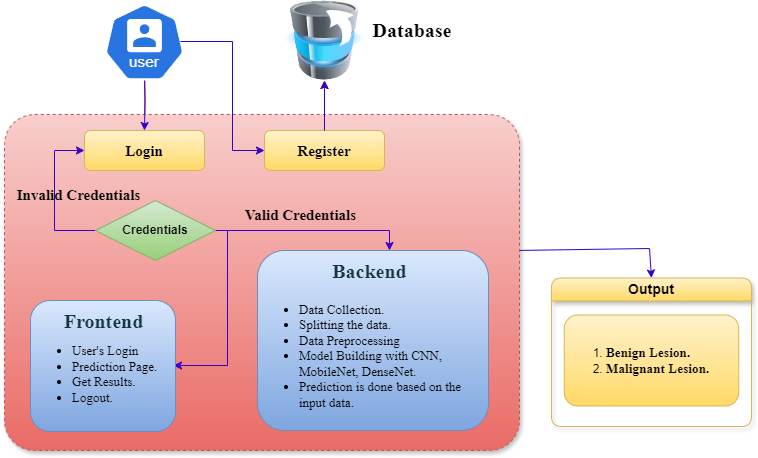
Block Diagram
Specifications
Hardware Requirements
Processor - I3/Intel Processor
Hard Disk - 160GB
Key Board - Standard Windows Keyboard
Mouse - Two or Three Button Mouse
Monitor - SVGA
RAM - 8GB
Software Requirements
• Operating System : Windows 7/8/10
• Programming Language : Python
• Libraries : Pandas, Numpy, scikit-learn.
• IDE/Workbench : Visual Studio Code.

Demo Video


Request for Video
 Paper Publishing
Request Call Back
Would you like to receive a free callback now?
Choose the best time for callback:
Leave your message and we will contact you as soon as possible

6-2-85/B, Old Maternity Hospital Road, Thyagaraja Nagar, Tirupati, Andhra Pradesh – 517501
+91 9030333433
+91 9393939065
0877-2261612

Disclaimer - Takeoff Edu Group Projects are not associated or affiliated with IEEE in any way. The IEEE Projects mentioned here are mentioned in the context of student projects, whose ideas are derived from IEEE publications, not projects of or by IEEE.

