AI Based Intrusion Detection System for Smart Healthcare Data Using Ensemble Machine Learning Techniques
Objective
The main objective of this project is to create a system that can accurately detect different types of cyber attacks on healthcare data. It aims to analyze patient and device parameters to identify anomalies that may indicate threats. By using ensemble machine learning techniques, the system improves detection accuracy and reduces false alarms. It provides a web-based interface for monitoring and reviewing attack predictions. Overall, the goal is to enhance the security and reliability of healthcare data systems.
Abstract
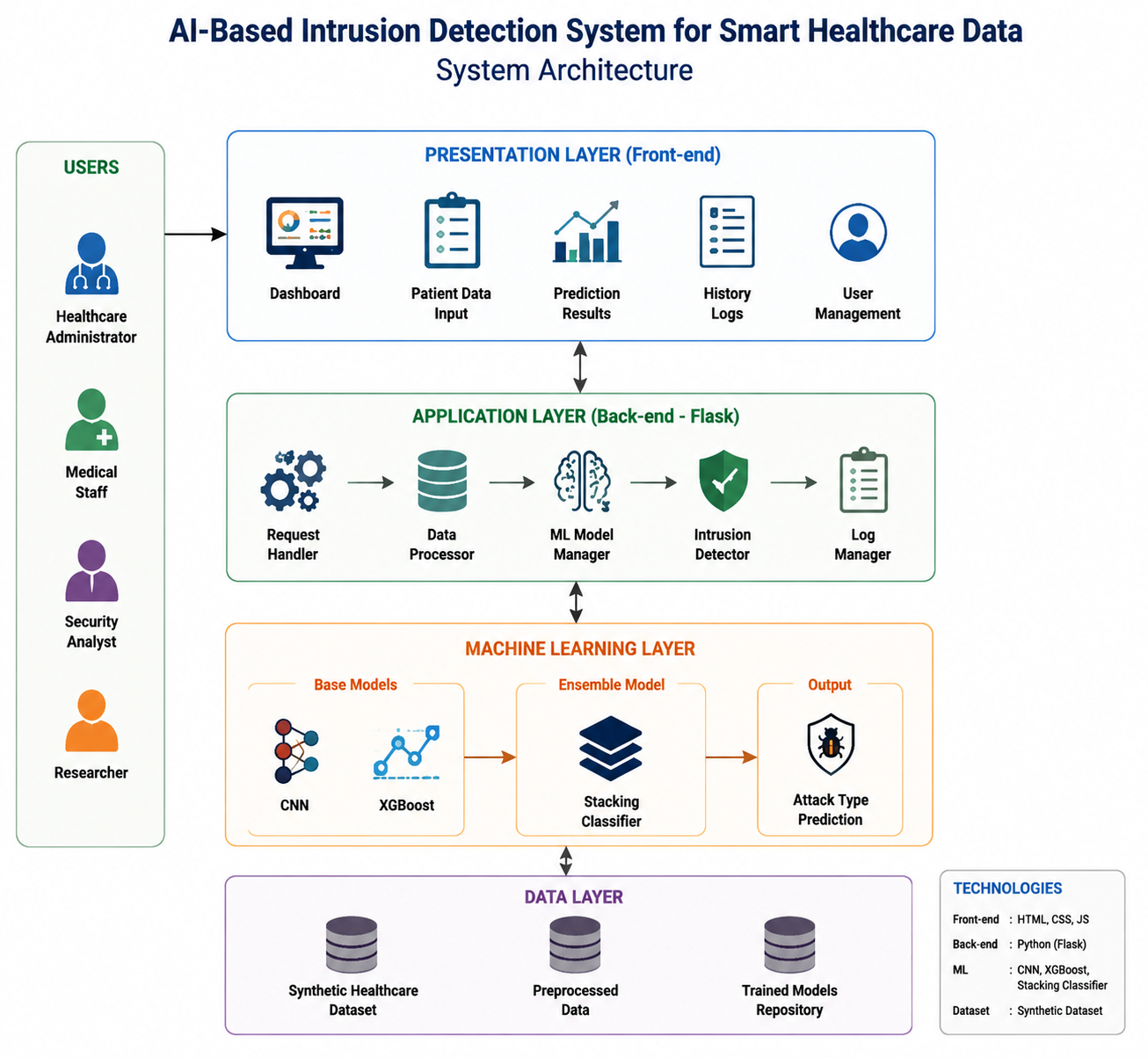
The rapid digitization of healthcare systems has increased the risk of cyberattacks targeting sensitive patient data. Protecting smart healthcare data is critical for maintaining confidentiality, integrity, and availability of patient information. This study presents an AI-based Intrusion Detection System (IDS) specifically designed for smart healthcare environments. The system utilizes a synthetic dataset consisting of physiological parameters such as temperature, heart rate, oxygen level, humidity, and ECG data. The IDS classifies inputs into multiple categories, including normal and various cyberattacks like Port Scanning, DDoS, TCP Vulnerability Scans, MITM, Botnet attacks, Data Tampering, and Malware Injection. The proposed framework integrates deep learning and ensemble methods, combining Convolutional Neural Networks (CNN) with XGBoost and a Stacking Classifier to enhance detection accuracy. The CNN captures temporal patterns from vital signals, while XGBoost efficiently handles tabular sensor data. The Stacking Classifier merges the predictions, improving overall performance. A Flask-based back-end handles data processing and inference, while a front-end built with HTML, CSS, and JavaScript provides an interactive interface for healthcare personnel. Experimental evaluation demonstrates the system’s ability to identify diverse attack types accurately. The model also incorporates explainability techniques to provide transparency in decision-making. This IDS framework offers a scalable and robust solution for safeguarding smart healthcare infrastructures against sophisticated cyber threats. The research contributes to improving cybersecurity in medical environments while maintaining data integrity and patient safety.
Keywords
Intrusion Detection, Smart Healthcare, Ensemble Learning, CNN, XGBoost, Stacking Classifier, Cybersecurity, ECG Analysis, Data Tampering, Malware Detection
NOTE: Without the concern of our team, please don't submit to the college. This Abstract varies based on student requirements.
Block Diagram
Specifications
4.1 SOFTWARE REQUIREMENS
Operating System : Windows 7/8/10
Server side Script : html,css,js
Programming Language : Python
Libraries : Django, Pandas, Torch, Keras, Sklearn, Numpy , Seaborn
IDE/Workbench : VSCode
Server Deployment : Xampp Server
Database : SQLite
4.2 HARDWARE REQUIREMENTS
Processor - I3/Intel Processor
RAM - 8GB (min)
Hard Disk - 128 GB
Key Board - Standard Windows Keyboard
Mouse - Two or Three Button Mouse
Monitor - Any


 Paper Publishing

Request Call Back
Would you like to receive a free callback now?
Choose the best time for callback:
Leave your message and we will contact you as soon as possible

6-2-85/B, Old Maternity Hospital Road, Thyagaraja Nagar, Tirupati, Andhra Pradesh – 517501
+91 9030333433
+91 9393939065
0877-2261612

Disclaimer - Takeoff Edu Group Projects are not associated or affiliated with IEEE in any way. The IEEE Projects mentioned here are mentioned in the context of student projects, whose ideas are derived from IEEE publications, not projects of or by IEEE.

