AI-Based Intelligent Garbage Classification and Disposal System
Objective
The objective is to develop an AI-based system that classifies and disposes of waste into categories such as biodegradable, recyclable, and hazardous, promoting recycling and sustainable waste management.
Abstract
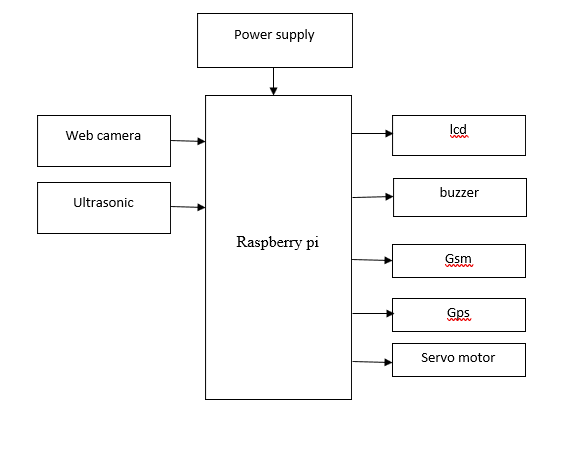
This project presents an AI-Based Intelligent Garbage Classification and Disposal System that automates waste segregation using image recognition and embedded electronics. A Raspberry Pi with a USB web camera captures images of waste, which are processed by a trained AI model to classify them as biodegradable or recyclable. Based on the classification, servo motors operate flaps or compartments to direct the waste accordingly. An ultrasonic sensor detects objects to trigger the system, while a DC motor and motor driver support additional movement like a lid or conveyor. A buzzer gives feedback to the user, and a GSM module sends alerts, such as bin status. The system runs on a 12V adapter with a power supply, and uses a memory card to store data. This smart bin reduces manual effort, improves recycling, and supports cleaner waste disposal in homes or public spaces.
NOTE: Without the concern of our team, please don't submit to the college. This Abstract varies based on student requirements.
Block Diagram
Specifications
Hardware Requirements:
- Raspberry pi
- Memory card
- Usb web camera
- Ultrasonic sensor
- Gsm
- Servo motor
- Buzzer
- Lcd
- Power supply
- Gps
Software requirements:
- Raspbean os
- python idle
Learning Outcomes
Understanding Raspberry pi pin diagram and architecture
Installing and configuring python IDE for Raspberry pi
Setting up Raspberry pi for multi-sensor
Basic coding with Raspberry pi for applications
Working with heart beat sensor
Interfacing LCD with Arduino for real-time display
Interfacing usb web camera with Raspberry pi
Interfacing heart sensor with Raspberry pi
Interfacing Temperature sensor with Raspberry pi
Interfacing buzzer with Raspberry pi
Understanding power supply requirements for wearable devices
About Project Development Life Cycle:
- Planning and Requirement Gathering (software, tools, hardware components, etc.)
- Schematic preparation
- Code development and debugging
- Hardware setup and debugging
- Development of the Project and Output testing
Practical exposure to:
- Hardware and software tools
- Solution providing for real-time problems
- Working with a team/individually
- Working on creative ideas
Project development skills:
- Problem analysis
- Problem solving
- Creativity and imagination
- Programming skills (Python)
- Deployment
- Testing
- Debugging
- Project presentation
- Report writing


 Paper Publishing

Request Call Back
Would you like to receive a free callback now?
Choose the best time for callback:
Leave your message and we will contact you as soon as possible

6-2-85/B, Old Maternity Hospital Road, Thyagaraja Nagar, Tirupati, Andhra Pradesh – 517501
+91 9030333433
+91 9393939065
0877-2261612

Disclaimer - Takeoff Edu Group Projects are not associated or affiliated with IEEE in any way. The IEEE Projects mentioned here are mentioned in the context of student projects, whose ideas are derived from IEEE publications, not projects of or by IEEE.

