AI-Assisted Diagnosis of Neonatal Ear Anomalies Using ResNet50 CBAM and CNN Transformer Models
Objective
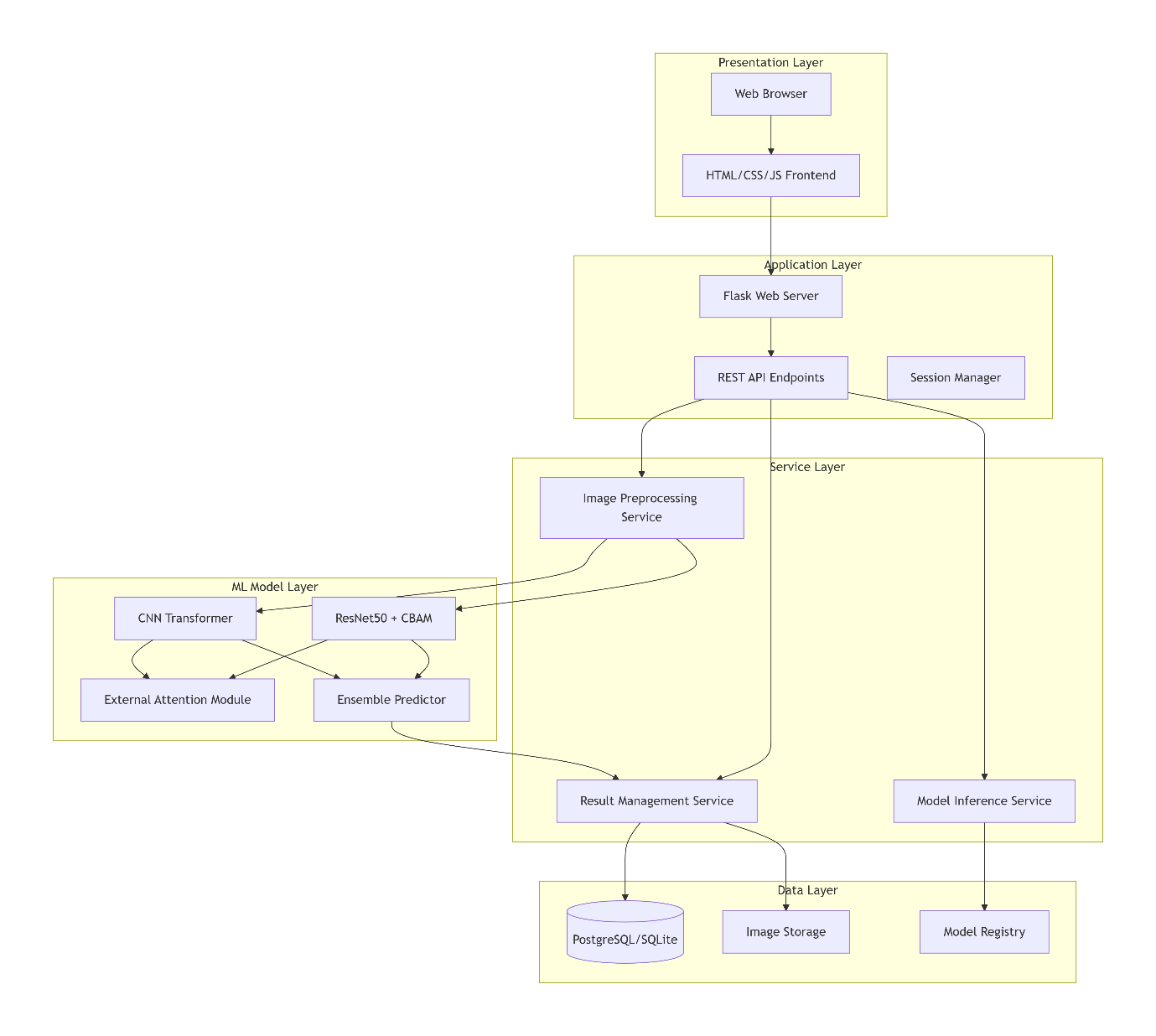
Develop a high-accuracy image classification system for nine neonatal ear anomalies using deep learning. ResNet50 with CBAM and CNN-Transformer extract hierarchical and global features from the BabyEar4k dataset (preprocessed via resizing, normalization, quality filtering). A modular web interface enables secure image upload, prediction, and result storage. Model performance is evaluated using accuracy, precision, recall, F1-score, and confusion matrices. The final AI-assisted tool aims to standardize diagnosis, reduce errors, and support clinical research with interpretable predictions.
Abstract
This project presents an AI-assisted framework for image classification of neonatal ear anomalies. The system integrates ResNet50 enhanced with Convolutional Block Attention Module (CBAM) and CNN Transformer architectures to classify auricle images into nine categories, including Normal, Prominent ear, Stahl ear, and other deformities. Using the BabyEar4k dataset, images are preprocessed through resizing, normalization, and quality filtering before input to the models. The framework combines local feature extraction with attention mechanisms to focus on critical regions while capturing global contextual patterns. Models are trained using cross-entropy loss and optimized for accuracy through learning rate scheduling. Performance is evaluated using metrics such as accuracy, precision, recall, F1-score, and confusion matrices to provide a comprehensive assessment of classification performance. The system is implemented as a web application with Flask for backend operations and HTML/CSS/JavaScript for frontend interaction. Users can upload images, receive predictions with associated probabilities, and store results for review. The proposed approach demonstrates high accuracy and robustness in classifying neonatal ear images, providing a standardized tool for anomaly detection.
Keywords: Neonatal ear anomalies, Image classification, ResNet50, CBAM, CNN Transformer, BabyEar4k dataset, Deep learning, Attention mechanism, Auricle deformities, AI-assisted diagnosis
NOTE: Without the concern of our team, please don't submit to the college. This Abstract varies based on student requirements.
Block Diagram
Specifications
SOFTWARE REQUIREMENS
Operating System : Windows 7/8/10
Server side Script : HTML, CSS & JS
Programming Language : Python
Libraries : scikit-learn, pandas, numpy, matplotlib, seaborn, TensorFlow, Keras, Flask, SQLAlchemy.
IDE/Workbench : VSCode
Server Deployment : MYSQL
Database : MySQL
HARDWARE REQUIREMENTS
Processor - I3/Intel Processor
RAM - 8GB (min)
Hard Disk - 128 GB
Key Board - Standard Windows Keyboard
Mouse - Two or Three Button Mouse
Monitor - Any


 Paper Publishing

Request Call Back
Would you like to receive a free callback now?
Choose the best time for callback:
Leave your message and we will contact you as soon as possible

6-2-85/B, Old Maternity Hospital Road, Thyagaraja Nagar, Tirupati, Andhra Pradesh – 517501
+91 9030333433
+91 9393939065
0877-2261612

Disclaimer - Takeoff Edu Group Projects are not associated or affiliated with IEEE in any way. The IEEE Projects mentioned here are mentioned in the context of student projects, whose ideas are derived from IEEE publications, not projects of or by IEEE.

