Advanced Smart Energy Saving System for Modern Railway Station Platform
Also Available Domains IOT
Objective
The main objective of this project is non-emergency equipment in public building, during non-working hours 4am- 8am there is no need of power and hence power can be saved for modern railway station platform.
Abstract
In recent years, the energy performance of public buildings has attracted substantial attention due to the significant energy-saving potential. As a semi-open high-space building, the high-speed railway station is obviously different from other public buildings and even traditional stations in terms of energy consumption and internal environment. Technology for using onboard storage batteries to save energy was first commercialized in the form of a series hybrid drive system for reducing the fuel consumption of diesel trains running on non-electrified railway lines.
This project investigates the current energy consumption situation and environmental quality of 15 high-speed railway passenger stations in China. Results show that the energy consumption of the high-speed railway station is between 117–470 kWh/(m2 ·a). The energy consumption of the station is related to the area and the passenger flow. The energy use of the station using district heating is higher than that of the station without district heating in the same region. The higher glazing ratio induces good natural lighting in the station, but the uniformity of the lighting in the station is not good. The acceptable temperature range of passengers in winter is larger than that in summer.
The average air change rate of the high-speed railway station is 3.2 h−1 in winter and 1.8 h−1 in summer, which is the main reason of high energy consumption of the HVAC (Heating Ventilation Air Conditioning) system in this kind of building. We are using solar panel and it takes the sun light and converts into electrical power and that power is stored into battery and by using that we can save the power.
Keywords: solar panel, battery, temperature sensor, LDR, fan, led, driver circuit
NOTE: Without the concern of our team, please don't submit to the college. This Abstract varies based on student requirements.
Block Diagram
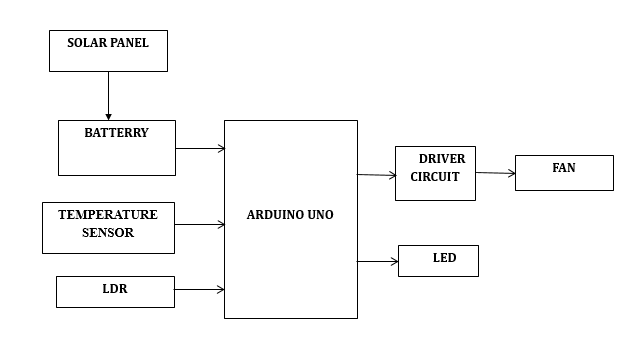
Specifications
Hardware Requirements:
- Arduino UNO
- Battery
- Solar panel
- Temperature sensor
- LDR
- Fan
- Driver circuit
- Led
Software Requirements:
- Arduino IDE
- Embedded C
- Fritzing
Learning Outcomes
- Arduino UNO Pin diagram and Architecture.
- How to install Arduino IDE Software.
- Setting up and Installation procedures for Arduino UNO.
- Introduction to Arduino IDE.
- Commands in Arduino.
- Basic coding in Arduino.
- Working of solar panel
- How to connect solar panel with the Arduino UNO?
- Working of temperature sensor
- How to interface temperature sensor with arduino Uno?
- Working of LDR
- How to interface LDR with Arduino Uno?
- Working of driver circuit
- How to interface driver circuit with Arduino Uno?
- Working of LED
- How to interface LED with Arduino Uno?
- About Project Development Life Cycle:
- Planning and Requirement Gathering( software’s, Tools, Hardware components, etc.,)
- Schematic preparation
- Code development and debugging
- Hardware development and debugging
- Development of the Project and Output testing
- Practical exposure to:
- Hardware and software tools. ,
- Solution providing for real time problems,
- Working with team/ individual,
- Work on Creative ideas.
- Project development Skills
- Problem analyzing skills
- Problem solving skills
- Creativity and imaginary skills
- Programming skills
- Deployment
- Testing skills
- Debugging skills
- Project presentation skills
- Thesis writing skills


 Paper Publishing

Request Call Back
Would you like to receive a free callback now?
Choose the best time for callback:
Leave your message and we will contact you as soon as possible

6-2-85/B, Old Maternity Hospital Road, Thyagaraja Nagar, Tirupati, Andhra Pradesh – 517501
+91 9030333433
+91 9393939065
0877-2261612

Disclaimer - Takeoff Edu Group Projects are not associated or affiliated with IEEE in any way. The IEEE Projects mentioned here are mentioned in the context of student projects, whose ideas are derived from IEEE publications, not projects of or by IEEE.

