Advanced PET Control for Voltage Sags Unbalanced Conditions Using Phase-Independent VSC-Rectification
Objective
The main objective of this project is to eliminates the harmonics, balancing the currents and maintain the unity power factor.
Abstract
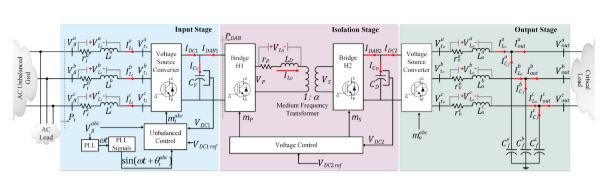
The power electronic transformer (PET) is an emerging technology that is quickly becoming a key component of the next-to-come power distribution networks (PDNs), due to its versatility on energy management, as well as, the improvement on the quality of the energy. PDNs are characterized by their unbalanced conditions, causing that PETs driven by conventional dq0 controls introduce current distortions on the primary winding of the transformer. Such distortion is evidenced in the 2ω oscillations of Vd and Vq acting as harmonic sources.
In this sense, this paper proposes a novel control approach for PETs. The key idea behind of this proposal consists of operating each phase independently, which is achieved through the enclosed rectification and the mitigation of the 2ω oscillations in a Dual Active Bridge (DAB) topology. The attained advantages by this control scheme are: (a) balancing of the primary winding currents; (b) unitary power factor; (c) negligible harmonic distortion; and (d) 2ω oscillation mitigation on the DC bus.
Index Terms—AC-DC-AC, power conversion, power electronic transformer, dual active bridge, VSC, unbalanced control, voltage sags, unbalanced input voltages.
NOTE: Without the concern of our team, please don't submit to the college. This Abstract varies based on student requirements.
Block Diagram
Specifications
Software Configuration:
Operating System : Windows 7/8/10
Application Software : Matlab/Simulink
Hardware Configuration:
RAM : 8 GB
Processor : I3 / I5(Mostly prefer)
Learning Outcomes
- Introduction to Matlab/Simulink
- What is EISPACK & LINPACK
- How to start with MATLAB
- About Matlab language
- About tools & libraries
- Application of Matlab/Simulink
- About Matlab desktop
- Features of Matlab/Simulink
- Basics on Matlab/Simulink
- Introduction to batteries.
- Design of batteries.
- Study of DC Source.
- Design of bidirectional converters
- Introduction to low pass filters
- Introduction to PWM techniques
- Design of Multi-Level Inverters.
- Design of Cascaded H Bridge Multi level Inverters.
- Introduction to Voltage Source Inverters.
- Analysis of Gating pulses.
- Introduction to IGBT switches.
- We can learn about MOSFETS.
- We can learn about TRIAC’S.
- Study of PWM techniques.
- Design of PWM techniques.
- Study of energy storage systems.
- Study of Phase Locked Loops
- Study of pulse generators
- Project Development Skills:
- Problem analyzing skills
- Problem solving skills
- Creativity and imaginary skills
- Programming skills
- Deployment
- Testing skills
- Debugging skills
- Project presentation skills
- Thesis writing skills
Demo Video


Request for Video
 Paper Publishing
Request Call Back
Would you like to receive a free callback now?
Choose the best time for callback:
Leave your message and we will contact you as soon as possible

6-2-85/B, Old Maternity Hospital Road, Thyagaraja Nagar, Tirupati, Andhra Pradesh – 517501
+91 9030333433
+91 9393939065
0877-2261612

Disclaimer - Takeoff Edu Group Projects are not associated or affiliated with IEEE in any way. The IEEE Projects mentioned here are mentioned in the context of student projects, whose ideas are derived from IEEE publications, not projects of or by IEEE.

