Advanced Neural Network Models for Optimal Energy Management in Microgrids with Integrated Electric Vehicle
Objective
This project aims to develop a neural network-based model to optimize energy management in microgrids, focusing on EV charging. It will predict optimal charging schedules based on factors like solar power, battery state of charge, and grid supply, minimizing grid reliance. The system will prioritize renewable energy use, reducing costs and enhancing sustainability.
Abstract
The integration of Electric Vehicles (EVs) into microgrids is becoming a key component of modern energy systems, driven by the need for sustainable and efficient energy solutions. However, managing energy resources in such systems is increasingly complex due to the variable nature of renewable energy sources like solar power and the dynamic charging demands of EVs. Traditional energy management systems often fail to address the intricacies of balancing solar energy generation, battery storage, and grid energy supply with the fluctuating charging needs of EVs. This project aims to develop an advanced neural network-based model for optimal energy management in microgrids with integrated EVs. Using a comprehensive dataset that includes key parameters such as solar power, battery state of charge (SOC), grid energy supply, EV charging power, and energy demand response, the model will predict the optimal charging schedules for EVs. The goal is to maximize the use of available renewable energy, reduce dependence on grid electricity, and lower overall energy costs while ensuring the efficient utilization of the microgrid’s resources. The system will use classification algorithms to identify the best charging decisions based on real-time input data. The outcome will be an intelligent, scalable, and adaptive energy management framework capable of supporting microgrids with high EV integration. By providing real-time decision-making, the system will contribute to the broader goal of sustainable energy management and enhance the role of renewable energy in the future grid infrastructure.
Keywords: Microgrid, Electric Vehicles, Neural Networks, Energy Management, Solar Power, Charging Optimization, Battery SOC, Grid Energy, Demand Response, Classification
NOTE: Without the concern of our team, please don't submit to the college. This Abstract varies based on student requirements.
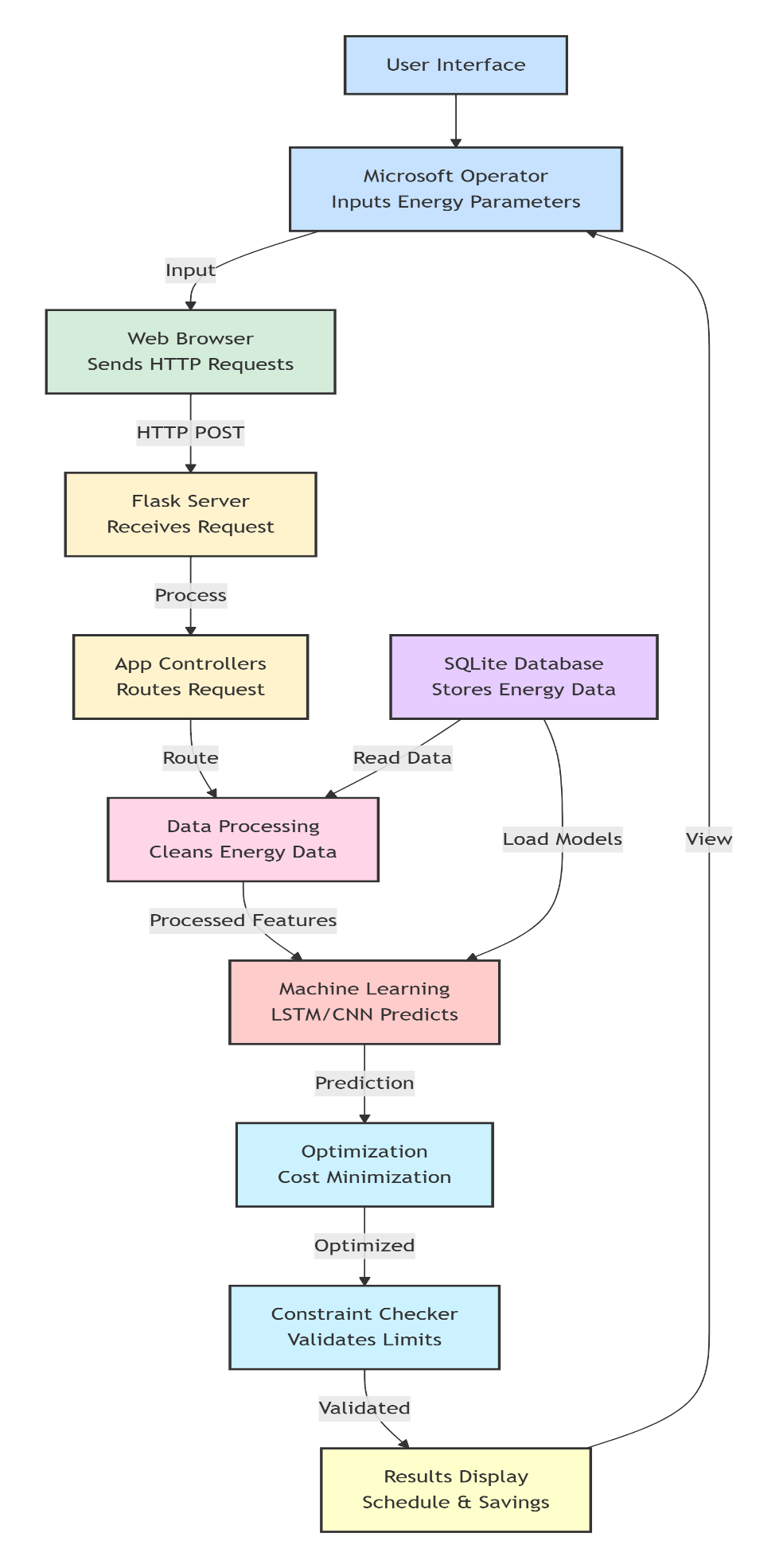
Block Diagram
Specifications
HARDWARE REQUIREMENTS
• Processor - I5/Intel Processor
• RAM - 8GB (min)
• Hard Disk - 160 GB
• Key Board - Standard Windows Keyboard
• Mouse - Two or Three Button Mouse
• Monitor - Any
SOFTWARE REQUIREMENS
• Operating System : Windows 7/8/10
• Server side Script : HTML, CSS, Bootstrap & JS
• Programming Language : Python
• Libraries : Flask, Pandas, Mysql. connector, Os, Numpy, Scikit- learn, sklearn, Preprocessor, tensor flow, keras
• IDE/Workbench : VS-Code
• Technology : Python 3.10+
• Server Deployment : Xampp Server
• Database : MySQL


 Paper Publishing

Request Call Back
Would you like to receive a free callback now?
Choose the best time for callback:
Leave your message and we will contact you as soon as possible

6-2-85/B, Old Maternity Hospital Road, Thyagaraja Nagar, Tirupati, Andhra Pradesh – 517501
+91 9030333433
+91 9393939065
0877-2261612

Disclaimer - Takeoff Edu Group Projects are not associated or affiliated with IEEE in any way. The IEEE Projects mentioned here are mentioned in the context of student projects, whose ideas are derived from IEEE publications, not projects of or by IEEE.

