Advanced Machine Learning Models for Efficient Medical Diagnosis
Objective
The objective of this project is to develop a machine learning-based medical diagnostic system that not only delivers accurate disease predictions but also offers clear and interpretable insights into the reasoning behind those predictions. The project aims to implement algorithms such as Random Forest, XGBoost, Logistic Regression, and Gradient Boosting to classify diseases based on medical data. A key focus is on ensuring the explain ability of the models, allowing healthcare professionals to understand the factors influencing the predictions. Additionally, the system will be evaluated on performance metrics such as accuracy, precision, recall, and F1-score to ensure high reliability and effectiveness. The goal is to create a user-friendly web platform that enables seamless interaction with the system, providing healthcare professionals with valuable predictive insights and explanations to support informed decision-making. Ultimately, the project seeks to enhance the trust and adoption of AI-driven diagnostic tools in healthcare by combining high predictive performance with transparency in decision-making.
Abstract
The project titled Advanced Machine Learning Models for Efficient Medical Diagnosis aims to provide an efficient, interpretable approach to disease diagnosis using machine learning. By applying algorithms such as Random Forest, XGBoost, Logistic Regression, and Gradient Boosting, the system classifies diseases based on medical data. One of the key features of this project is its focus on the explainability of model predictions, allowing users to understand the reasoning behind the model’s decisions. The system uses a dataset containing medical features related to various diseases, ensuring the models are trained to accurately predict diagnoses. The project uses a web-based interface for easy interaction, where users can input patient data and receive predicted diagnoses along with interpretive insights. The algorithms are evaluated on their performance, ensuring high accuracy, precision, and recall. By incorporating explainable AI techniques, this project addresses the need for transparency in medical decision-making processes, providing healthcare professionals with a tool to make better-informed decisions.
Keywords: Machine learning, medical diagnosis, Random Forest, XGBoost, Logistic Regression, Gradient Boosting, explainability, prediction, disease classification, AI models.
NOTE: Without the concern of our team, please don't submit to the college. This Abstract varies based on student requirements.
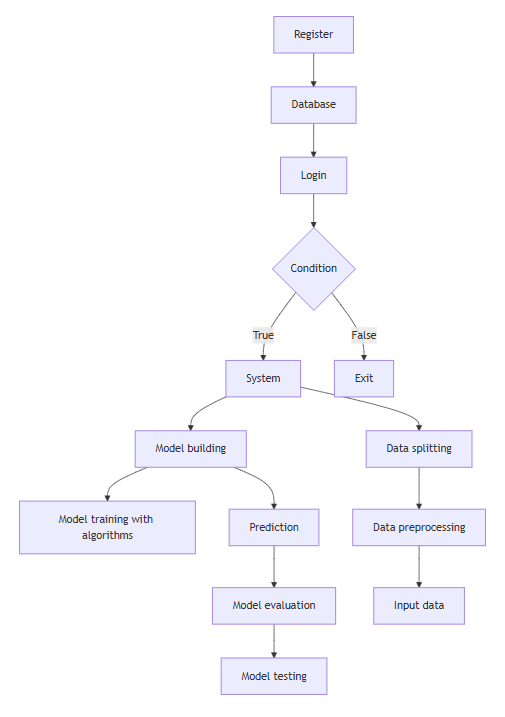
Block Diagram
Specifications
Hardware Requirements
Processor - I3/Intel Processor
Hard Disk - 160GB
Key Board - Standard Windows Keyboard
Mouse - Two or Three Button Mouse
Monitor - SVGA
RAM - 8GB
Software Requirements:
Operating System : Windows 7/8/10
Server side Script : HTML, CSS, Bootstrap & JS
Programming Language : Python
Libraries : Flask, Pandas, Mysql.connector, Os, Smtplib, Numpy
IDE/Workbench : VSCODE
Technology : Python 3.6+
Server Deployment : Xampp Server
Database : MySQL


 Paper Publishing

Request Call Back
Would you like to receive a free callback now?
Choose the best time for callback:
Leave your message and we will contact you as soon as possible

6-2-85/B, Old Maternity Hospital Road, Thyagaraja Nagar, Tirupati, Andhra Pradesh – 517501
+91 9030333433
+91 9393939065
0877-2261612

Disclaimer - Takeoff Edu Group Projects are not associated or affiliated with IEEE in any way. The IEEE Projects mentioned here are mentioned in the context of student projects, whose ideas are derived from IEEE publications, not projects of or by IEEE.

