Advanced Heart Attack Risk Prediction Using Stacked Hybrid Machine Learning
Objective
The objective of this project is to develop a robust machine learning framework for predicting the risk of heart disease, utilizing advanced hybrid models to enhance prediction accuracy. The project aims to compare the performance of several classification techniques, including Stacked Autoencoder with Random Forest, a Hybrid model combining XGBoost and LightGBM, Stacking Classifier, and Voting Classifier. By leveraging the strengths of these algorithms, the goal is to improve the reliability of heart disease predictions, contributing to early diagnosis and timely intervention. The project also seeks to demonstrate the potential of hybrid machine learning approaches in healthcare applications.
Abstract
Heart disease remains one of the primary causes of mortality globally, emphasizing the need for accurate early detection systems. This paper presents a comprehensive framework for predicting the risk of heart disease using advanced machine learning techniques. We propose hybrid models that combine several state-of-the-art classification algorithms to improve prediction accuracy. Specifically, we evaluate and compare models such as Stacked Autoencoder with Random Forest, a Hybrid model combining XGBoost and LightGBM, the Stacking Classifier, and the Voting Classifier. These models are trained on a dataset sourced from Kaggle, which includes key features such as age, cholesterol levels, blood pressure, and medical history. The hybridization of these algorithms leverages their individual strengths to enhance the performance of the prediction system. By stacking models and using voting mechanisms, the proposed approach aims to provide more reliable and precise predictions. The results demonstrate that hybrid models outperform traditional single-model approaches, offering significant promise in the early detection of heart disease. This research contributes to the ongoing efforts in utilizing machine learning for healthcare, specifically in reducing the mortality rate associated with heart disease through timely and accurate predictions.
Keywords: Heart disease prediction, Machine learning, Stacked Autoencoder, Random Forest, XGBoost, LightGBM, Stacking Classifier, Voting Classifier, Early detection, Hybrid models, Healthcare, Kaggle dataset.
NOTE: Without the concern of our team, please don't submit to the college. This Abstract varies based on student requirements.
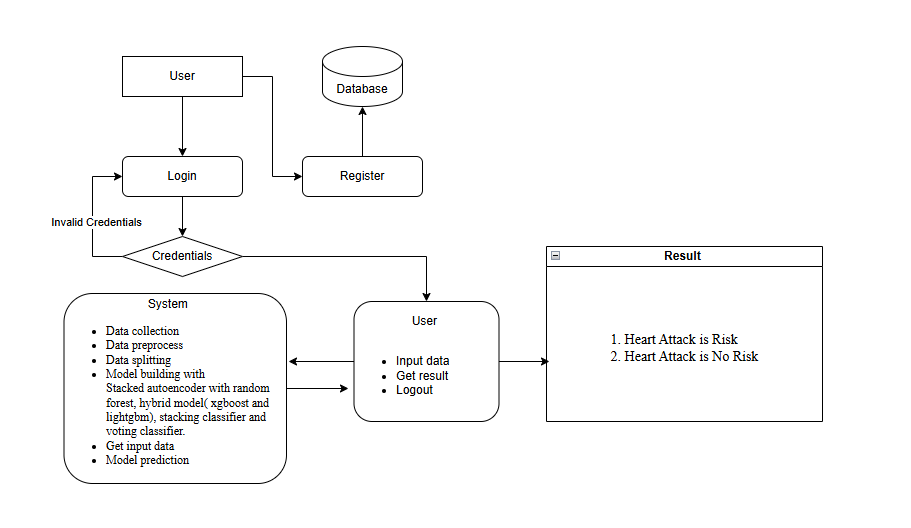
Block Diagram
Specifications
Hardware Requirements
Processor - I3/Intel Processor
Hard Disk - 160GB
Key Board - Standard Windows Keyboard
Mouse - Two or Three Button Mouse
Monitor - SVGA
RAM - 8GB
Software Requirements:
Operating System : Windows 7/8/10
Server side Script : HTML, CSS, Bootstrap & JS
Programming Language : Python
Libraries : Django, Pandas, Numpy, Tensorflow, Scikit-learn.
IDE/Workbench : VS Code
Technology : Python 3.10
Database : SQLite

Demo Video


Request for Video
 Paper Publishing
Request Call Back
Would you like to receive a free callback now?
Choose the best time for callback:
Leave your message and we will contact you as soon as possible

6-2-85/B, Old Maternity Hospital Road, Thyagaraja Nagar, Tirupati, Andhra Pradesh – 517501
+91 9030333433
+91 9393939065
0877-2261612

Disclaimer - Takeoff Edu Group Projects are not associated or affiliated with IEEE in any way. The IEEE Projects mentioned here are mentioned in the context of student projects, whose ideas are derived from IEEE publications, not projects of or by IEEE.

