Adaptive Integration of Steady-State Change Features for Enhanced Multi-Label Energy Disaggregation
Objective
The primary objective of this project is to develop an efficient and accurate energy disaggregation framework titled “Adaptive Integration of Steady-State Change Features for Enhanced Multi-Label Energy Disaggregation.” The proposed system utilizes Adaptive Feature-Temporal NILM (AFT-NILM), Lightweight Hybrid Interpretable NILM (LHI-NILM), and Hybrid Ensemble NILM (HE-NILM) to identify and classify multiple appliance operating states from aggregate energy consumption data. The framework focuses on adaptively integrating steady-state change features to capture appliance behavior and improve multi-label disaggregation performance. AFT-NILM is employed to learn feature-temporal relationships, LHI-NILM provides efficient and interpretable appliance-level predictions, and HE-NILM combines prediction outcomes to enhance overall accuracy and robustness. The project aims to improve appliance identification, increase disaggregation accuracy, reduce classification errors, and support effective energy monitoring and management systems.
Abstract
Energy disaggregation plays a vital role in
analyzing household and building energy consumption by identifying the
operating states of multiple appliances from aggregate power measurements.
However, achieving accurate multi-label energy disaggregation remains
challenging due to overlapping appliance signatures, variations in power
consumption patterns, and complex steady-state transitions. In this work, we
present an adaptive framework titled. The proposed methodology utilizes Adaptive Feature-Temporal NILM (AFT-NILM),
Lightweight Hybrid Interpretable NILM
(LHI-NILM), and Hybrid Ensemble
NILM (HE-NILM) to improve appliance-level identification and energy
disaggregation performance. Initially, steady-state change features are
adaptively integrated to capture significant variations in appliance operating
behavior. The extracted features are processed through AFT-NILM to learn
temporal consumption characteristics, while LHI-NILM provides efficient and
interpretable appliance-level disaggregation. Furthermore, HE-NILM combines the
strengths of multiple prediction mechanisms to enhance multi-label
classification accuracy and robustness. Experimental analysis demonstrates that
the proposed framework effectively identifies multiple appliance states from
aggregate energy signals and improves overall disaggregation performance. The
adaptive integration of steady-state change features, together with the
complementary capabilities of AFT-NILM, LHI-NILM, and HE-NILM, contributes to
more accurate, efficient, and reliable non-intrusive load monitoring for modern
energy management systems.
Keywords: Non-Intrusive Load Monitoring (NILM), Energy Disaggregation, Multi-Label Classification, Steady-State Change Features, Adaptive Feature-Temporal NILM (AFT-NILM), Lightweight Hybrid Interpretable NILM (LHI-NILM), Hybrid Ensemble NILM (HE-NILM), Appliance Identification, Energy Monitoring, Smart Energy Management.
NOTE: Without the concern of our team, please don't submit to the college. This Abstract varies based on student requirements.
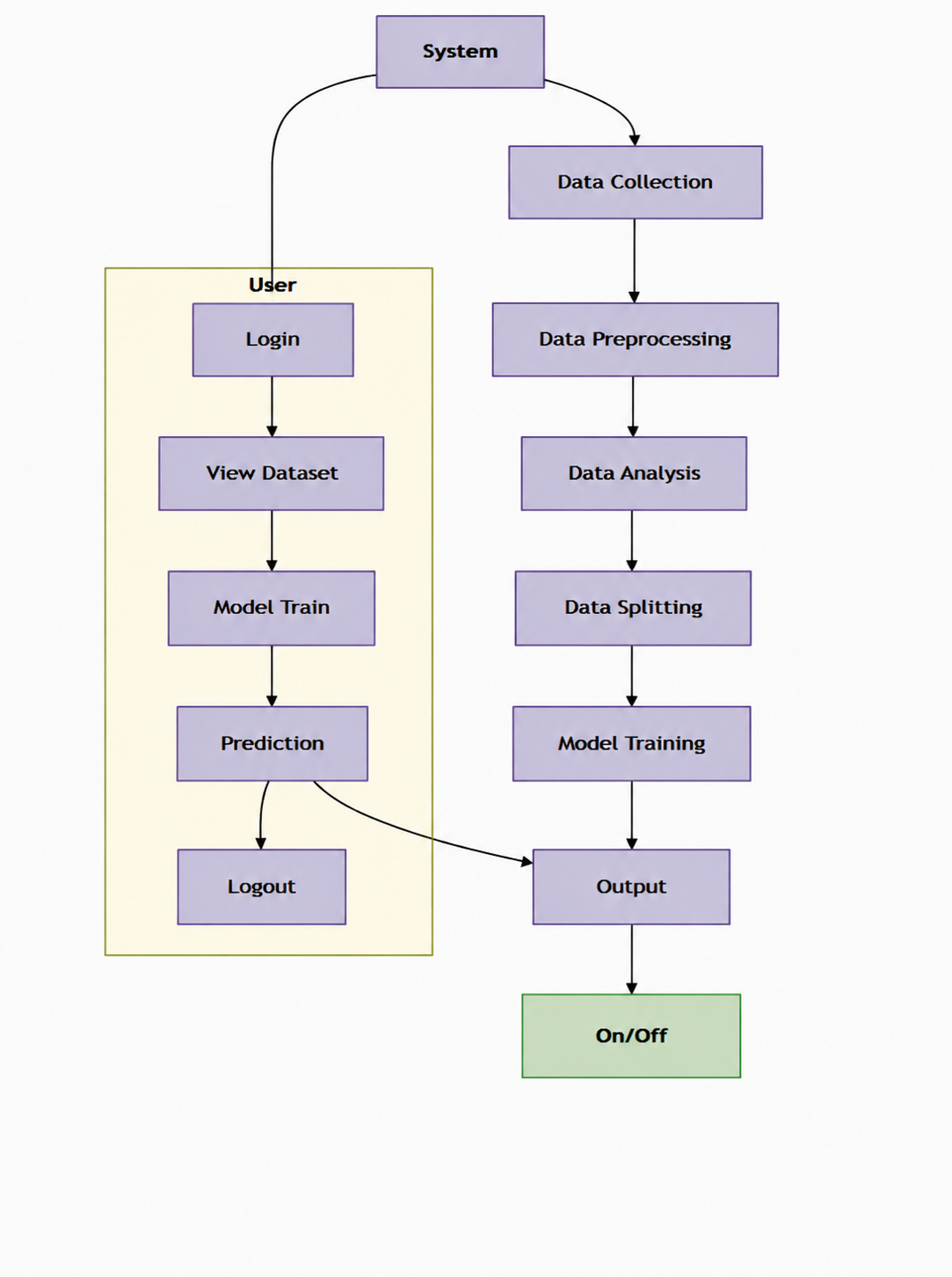
Block Diagram
Specifications
4.1 SOFTWARE REQUIREMENS
Operating System : Windows 7/8/10
Server side Script : HTML, CSS, Bootstrap & JS
Programming Language : Python
Libraries : Flask,Torch, Keras, Pandas,Json, , Numpy , Seaborn
IDE/Workbench : VSCode
Server Deployment : Xampp Server
Database : SQLite
4.2 HARDWARE REQUIREMENTS
Processor - I3/Intel Processor
RAM - 8GB (min)
Hard Disk - 128 GB
Key Board - Standard Windows Keyboard
Mouse - Two or Three Button Mouse
Monitor - Any

Demo Video


Request for Video
 Paper Publishing
Request Call Back
Would you like to receive a free callback now?
Choose the best time for callback:
Leave your message and we will contact you as soon as possible

6-2-85/B, Old Maternity Hospital Road, Thyagaraja Nagar, Tirupati, Andhra Pradesh – 517501
+91 9030333433
+91 9393939065
0877-2261612

Disclaimer - Takeoff Edu Group Projects are not associated or affiliated with IEEE in any way. The IEEE Projects mentioned here are mentioned in the context of student projects, whose ideas are derived from IEEE publications, not projects of or by IEEE.

